
Advances in computational photography now allow your smartphone to produce images that rival those from high-end DSLRs. By combining sophisticated algorithms with hardware improvements, your phone can enhance photo quality in real-time, automatically adjusting focus, exposure, and colors. Light field technology captures more data, giving you the ability to refocus and modify depth after taking a shot. With AI and these innovations, mobile photography is becoming incredibly close to professional quality—continuing developments will further elevate your photography experience.

Turn quiet afternoons into listening time
- Thousands of audiobooks, podcasts and originals
- Listen on your phone, tablet or Echo — also offline
- Cancel anytime
Key Takeaways
- Advances in computational photography enable smartphones to produce high-quality images comparable to DSLRs.
- AI-driven enhancements optimize focus, exposure, and noise reduction automatically for professional-looking photos.
- Light field imaging allows post-capture adjustments like refocusing and depth control, mimicking DSLR effects.
- The synergy of AI and light field technology bridges the quality gap between mobile devices and professional cameras.
- These innovations make high-end photography accessible to smartphone users, challenging traditional DSLR dominance.
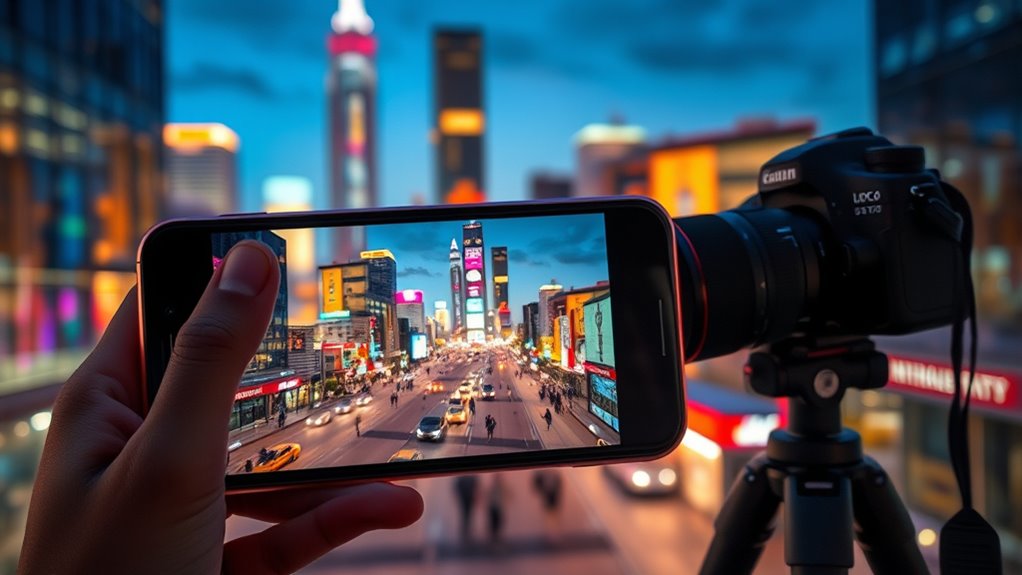
Have you ever wondered how smartphones capture stunning images with just a tap? It’s all thanks to advances in computational photography, which combines powerful algorithms with hardware improvements to produce results once reserved for high-end DSLRs. One key innovation fueling this progress is AI enhancement. Your phone’s AI algorithms analyze your scene in real-time, adjusting focus, exposure, and color balance to ensure ideal results. AI enhancement enables your device to recognize objects, improve details in shadows, and reduce noise, all while you’re still holding the camera. This smart processing allows for sharper images, even in challenging lighting conditions, without you needing to tweak settings manually.
AI-powered algorithms analyze scenes in real-time, optimizing focus, exposure, and noise reduction for stunning photos.
Another game-changing technology is light field imaging. Unlike traditional cameras that capture just a flat image, light field imaging records the direction and intensity of light rays entering the lens. This extra data means you can do things like refocus your shot after taking it or adjust the depth of field — all in software. When you take a photo with a phone supporting light field imaging, you’re capturing a richer dataset that your device can process to produce more versatile images. For example, if you want to emphasize a subject by blurring the background, your phone can simulate a shallow depth of field, mimicking DSLR effects. Conversely, you can also bring everything into sharp focus after the fact, giving you creative control that was once impossible without a dedicated camera.
These technologies work hand-in-hand to close the gap between smartphone cameras and traditional DSLRs. AI enhancement continuously refines the image, making adjustments on the fly, while light field imaging provides the flexibility to manipulate focus and depth after capturing the scene. This combination allows you to produce professional-looking photos with minimal effort, right from your pocket. The processing power behind these innovations is impressive: your phone’s software interprets complex data, applying sophisticated algorithms in real-time. As a result, you don’t need to be a professional photographer to get high-quality images; your device’s computational photography capabilities do the heavy lifting.
In essence, AI enhancement and light field imaging are transforming how you think about mobile photography. They empower you to take striking, versatile images that rival those from DSLRs, all with intuitive controls and simple taps. These advancements are making professional-grade photography accessible to everyone, changing the way we capture and share our world. Additionally, ongoing research in algorithmic processing continues to push the boundaries of what mobile devices can achieve in photography.
smartphone computational photography accessories
As an affiliate, we earn on qualifying purchases.
As an affiliate, we earn on qualifying purchases.
Frequently Asked Questions
How Do Smartphone Computational Photography Techniques Compare to Professional Editing Software?
You find that smartphone computational photography techniques deliver impressive results through real-time image processing and smart algorithms, allowing quick artistic enhancements like HDR, night mode, and portrait effects. While professional editing software offers more control and advanced tools for fine-tuning images, smartphones excel in convenience and instant results. Ultimately, both serve different needs—smartphones for on-the-spot captures and quick artistic tweaks, and editing software for detailed, polished adjustments.
Can Computational Photography Completely Replace Traditional DSLR Photography?
Think of computational photography as a bridge, not a complete replacement. While it enhances smartphone images through optical improvements and clever algorithms, sensor limitations still restrict its full potential. You can capture stunning moments, but for professional-level control and quality, especially in challenging conditions, a DSLR remains essential. So, no, it can’t entirely replace traditional photography, but it certainly transforms how you capture everyday scenes.
What Are the Limitations of Smartphone Computational Photography in Low-Light Conditions?
In low-light conditions, smartphone computational photography struggles with sensor noise, resulting in grainy images, and limited dynamic range, which causes loss of detail in shadows and highlights. You might notice that photos become less clear and more distorted despite advanced algorithms. While improvements are ongoing, these limitations mean smartphones can’t fully match the quality of high-end DSLRs in challenging lighting, especially when capturing fine details and true color accuracy.
How Does Computational Photography Affect the Natural Look of Images?
You might worry that computational photography makes images look artificial, but it actually enhances their natural look through digital enhancement. By intelligently adjusting lighting, contrast, and details, it preserves realism while reducing imperfections. This process balances technology and authenticity, ensuring your photos retain their true essence. Far from creating artificial realism, it helps you capture moments more accurately, giving you images that feel genuine and true to life.
What Future Advancements Are Expected in Smartphone Computational Photography Technology?
Future advancements in smartphone computational photography will likely include improved AI noise reduction, making images clearer even in low light, and real-time HDR, which enhances dynamic range instantly. You can expect cameras to become smarter and faster, capturing more natural and detailed photos without extra effort. These innovations will make your smartphone even more capable of producing professional-quality images in various conditions.
As an affiliate, we earn on qualifying purchases.
Conclusion
As you explore the world through your smartphone’s lens, remember that computational photography is rewriting the rules of what’s possible. With each shot, you hold the power to capture moments that rival DSLR quality—like a magician revealing the impossible. So, why settle for less? Embrace this new era of innovation and let your device tell stories as vivid as life itself. After all, the future of photography is just a tap away—waiting for you to open it.
AI smartphone camera enhancement
As an affiliate, we earn on qualifying purchases.
As an affiliate, we earn on qualifying purchases.
professional smartphone camera lens kit
As an affiliate, we earn on qualifying purchases.
As an affiliate, we earn on qualifying purchases.
Cold & flu season Picks
humidifiers
As an affiliate, we earn on qualifying purchases.