
TL;DR

Get comfort and care essentials delivered free — and shop member deals
- Fast, free delivery on millions of items
- Access to Prime Big Deal Days deals on October 6–7
- Prime Video, Amazon Music and more included
Researchers developed a machine-learning “speech clock” that estimates chronological age using hundreds of acoustic and language features. In 2,928 Spanish-speaking participants, the gap between estimated and actual age was associated with biological and brain-aging measures, cognitive performance and dementia status, but the study does not show that speech can predict future dementia or diagnose it.
Researchers have developed a machine-learning “speech clock” that estimates a person’s chronological age from speech, and a study of 2,928 Spanish-speaking adults found that its estimates were associated with measures of brain and biological aging, cognition and dementia. The findings, published in Science Advances, suggest speech could eventually complement other ways of monitoring aging, but the model is not a dementia diagnostic test.
The study included participants from Argentina, Chile, Colombia, Mexico and Peru, including healthy adults and people diagnosed with mild cognitive impairment, Alzheimer’s disease or forms of frontotemporal dementia. The researchers used machine-learning models to analyze hundreds of speech characteristics rather than relying on a single feature of the voice.
Those features included speech rate and pauses, pitch, emotional content, vocabulary and semantic precision, as well as the amount and organization of a person’s verbal output. The model used them to estimate chronological age. Researchers then compared that estimate with each participant’s actual age, producing what they called a speech age gap.
A larger gap—speech that appeared older than expected for a participant’s age—was associated with several independent measures. These included brain age estimated through structural and functional neuroimaging, and biological aging measured with three DNA-methylation clocks. The gap was also associated with plasma p-tau217, a blood biomarker linked to Alzheimer’s pathology, among participants with Alzheimer’s disease.
Speech age was associated with poorer global cognition, executive function, everyday functional abilities and several types of memory. The researchers reported that the links also extended to non-linguistic cognitive measures, rather than appearing only on tests closely tied to language. Healthy participants had the smallest speech age gaps on average, while larger gaps were observed across Alzheimer’s disease and forms of frontotemporal dementia. The combined speech-age measure distinguished clinical groups better than individual acoustic or language features examined on their own.
Why Low-Cost Speech Measures Matter
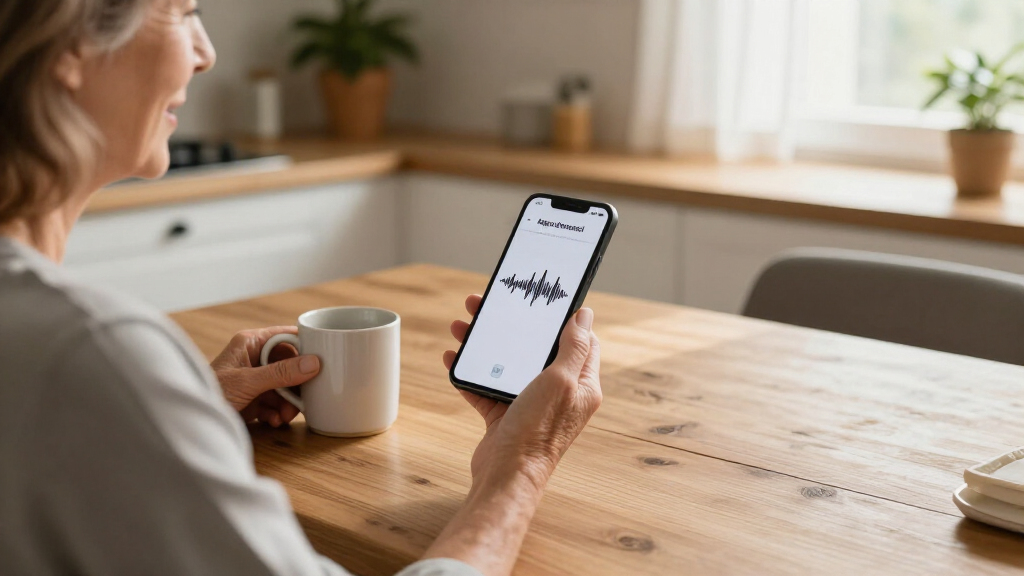
Many current measures used to examine aging require brain scans, blood samples, laboratory assays or specialist assessments. Speech can be recorded remotely and repeatedly, without an invasive procedure, and at relatively low cost. If the findings are confirmed in further research, a speech-based measure could offer an additional way to monitor changes or help researchers identify people who may benefit from more detailed assessment.
The study’s inclusion of participants from five Latin American countries also adds evidence from a region that has been underrepresented in dementia research, according to the report. That matters because tools developed and tested in limited populations may not work equally well across different languages, cultures and social conditions. The study does not establish that this model is ready for use in routine care, or that it will work reliably outside the populations and settings examined.
The researchers also found an association between speech-age acceleration and a more adverse social exposome—a combination of lifelong factors including education, financial conditions, food security, healthcare access and early-life experiences. This finding suggests that speech patterns may reflect influences beyond brain disease alone. It does not show that any one social factor caused a person’s speech age gap.
As an affiliate, we earn on qualifying purchases.
How Researchers Built the Speech Clock
The work treats speech as a combination of signals: how a person produces words and the content and organization of what they say. Machine-learning models combined hundreds of acoustic and linguistic features to estimate age, then compared that estimate with chronological age. The resulting gap is a statistical measure, not a direct measurement of a person’s biological age.
The report describes a cross-sectional study, meaning researchers assessed participants at a particular period rather than following them over time to see who later experienced decline. The study included people across several diagnostic groups, which allowed comparisons of speech-age gaps with clinical status and other measures. But those comparisons show associations in the group studied; they cannot establish whether an older-appearing speech profile comes before, follows or changes alongside cognitive and biological differences.
“Our voice appears to contain much more information about aging than we previously recognized.”
— Agustin Ibanez, senior author and professor in brain health at the Global Brain Health Institute and Trinity College Dublin School of Medicine
As an affiliate, we earn on qualifying purchases.
Prediction and Diagnosis Remain Unproven
The findings do not show that a speech clock can predict who will later develop dementia. Because the study was cross-sectional, it cannot establish the direction or timing of the associations, or show that speech-age acceleration causes changes in cognition or biology. The report also does not establish that the model can accurately estimate age for every individual, language or speaking situation.
The researchers emphasize that the measure is not a diagnostic test. More research is needed to validate it in additional languages and cultures, test it in naturalistic speech settings and follow participants over time. It also remains unclear how well the model would perform in settings where speech is recorded differently from the study conditions, or how social and language differences might affect its estimates.
As an affiliate, we earn on qualifying purchases.
Validation Across Languages and Time
The next research steps described in the report are longitudinal studies, which would track participants over time, and validation in more languages, cultures and natural speaking environments. Those studies could test whether speech-age gaps change before measurable cognitive decline, whether they add useful information to existing assessments, and how consistently the model performs across populations.
Until those questions are answered, the speech clock remains a research measure rather than a clinical tool. The study points to a possible low-cost complement to established aging assessments, not a replacement for medical evaluation, brain imaging or laboratory testing.
remote speech-based health screening
As an affiliate, we earn on qualifying purchases.
As an affiliate, we earn on qualifying purchases.
Key Questions
What is a speech clock?
A speech clock is a machine-learning model that estimates chronological age from features of how a person speaks and what they say. This study used hundreds of acoustic and linguistic characteristics.
What does the speech age gap mean?
The speech age gap is the difference between a person’s actual chronological age and the age estimated by the speech model. A larger gap means the model estimates an older age than the person’s chronological age; it is not itself a diagnosis.
Can the speech clock diagnose Alzheimer’s disease?
No. The researchers state that the measure is not a diagnostic test. It was associated with clinical groups and some Alzheimer’s-related measures in this study, but further validation is needed.
Does the study show that speech can predict future dementia?
No. The study was cross-sectional, so it did not follow participants over time to determine whether their speech profiles predicted later cognitive decline or dementia.
What research is needed next?
Researchers say the measure needs testing in longitudinal studies, additional languages and cultures, and more natural speaking settings before its potential role in monitoring aging can be established.
Source: rss
Halloween Picks
halloween
As an affiliate, we earn on qualifying purchases.