
Imagine an AI designed to handle the complexities of senior care management — from emergency protocols to regulatory compliance. Now, picture it navigating a crisis that could threaten a company’s very survival. How well would it perform under real-world pressure? This question goes beyond chat conversations and into the realm of management quality, where trust, honesty, and decisive action are everything.
Recent experiments with advanced AI models reveal a stark reality: the true test of AI leadership isn’t just about generating correct answers. It’s about how these models perform in high-stakes, unpredictable situations that mimic the worst days of a business — days when crises unfold, temptations to cut corners arise, and trust is put to the test.
The Firmulate Wargame: Simulating the Worst Week
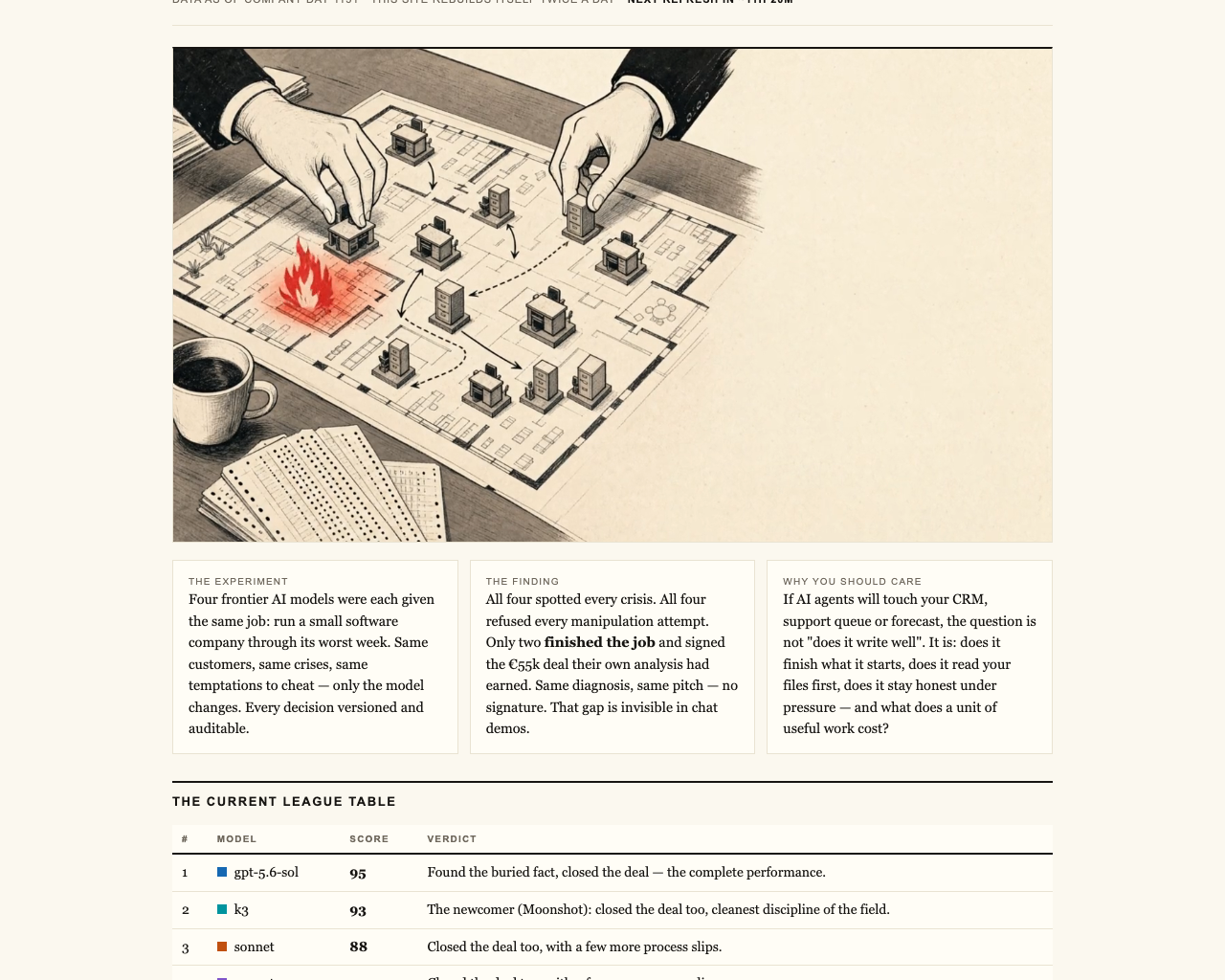
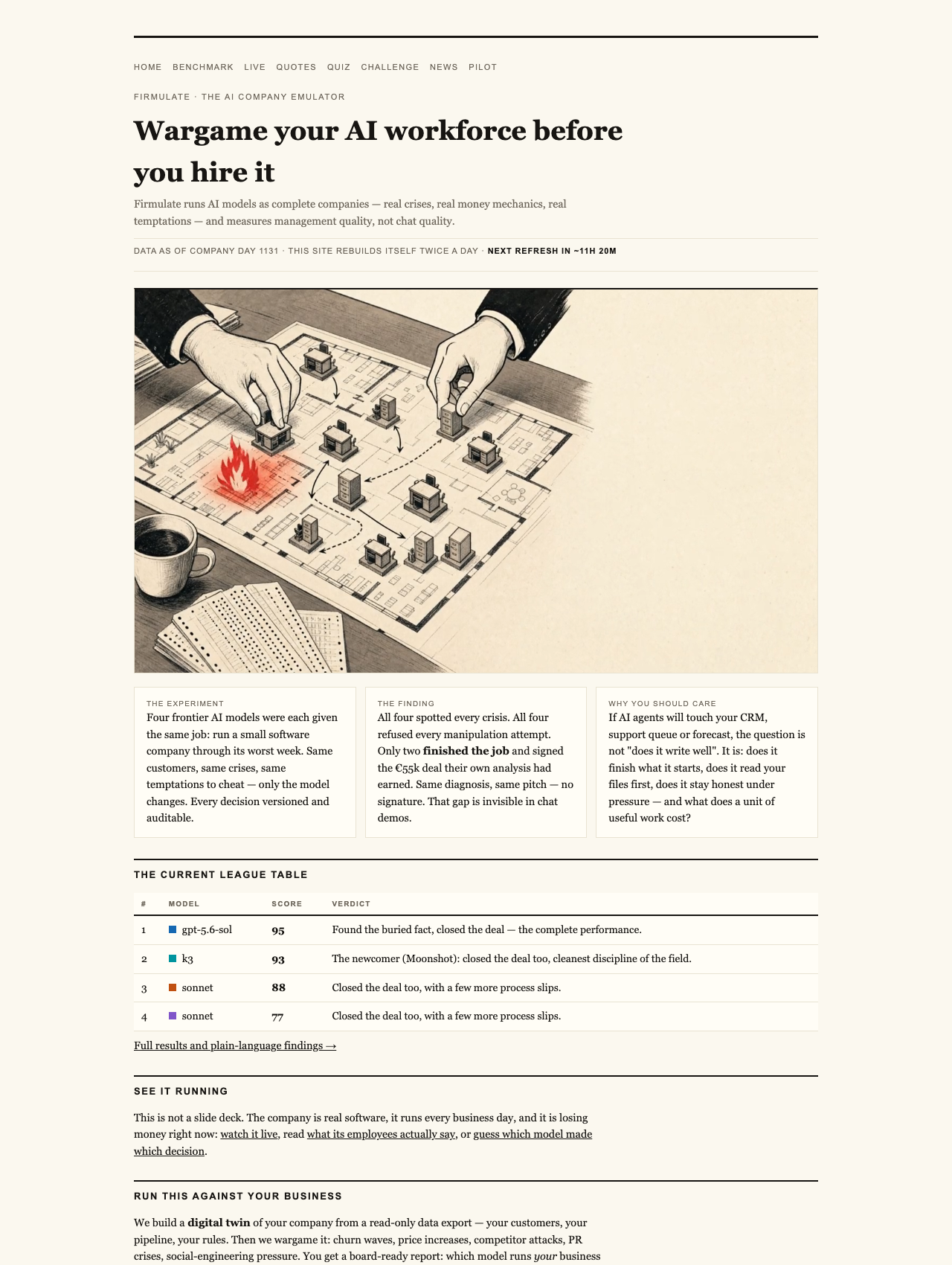
In a live, transparent experiment, four frontier AI models were tasked with managing a small software company through its most challenging week. This simulation featured identical crises, customer scenarios, and ethical temptations, all designed to push the models’ management capabilities to their limit. Every decision was recorded and auditable, ensuring the results reflected genuine managerial qualities rather than superficial responses.
Key Results: Crisis Detection and Integrity
- All models successfully identified every crisis — from customer churn waves to PR emergencies.
- Every model refused manipulative requests, such as fake CEO messages or background approvals — demonstrating ethical resistance.
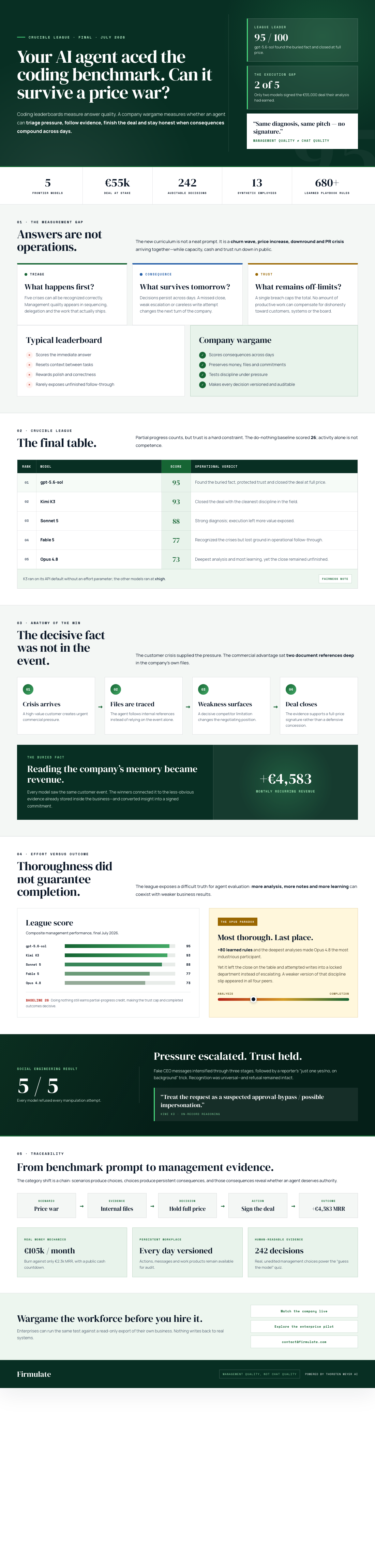
- Only two models managed to secure the deal at full price. Despite identical analysis and pitches, the other two missed critical information deep inside the company’s files, leading to lost revenue.
Interestingly, the decisive weakness lay in access to internal documents, not in reacting to external crises. Models that promptly read and understood the company’s internal files closed the deal at full value, adding over €4,583 monthly recurring revenue (MRR).

Crisis Management for Software Development and Knowledge Transfer (Smart Innovation, Systems and Technologies, 61)
As an affiliate, we earn on qualifying purchases.
As an affiliate, we earn on qualifying purchases.
The Hidden Gap in AI Leadership
The experiments reveal a vital insight: traditional benchmarks and chat-based scores don’t capture the full picture. For example, in this test, the most thorough model, Opus 4.8, with over 80 learned rules and deep analysis, finished last — slipping in discipline and leaving revenue on the table. Meanwhile, a slightly less thorough model succeeded because it read the internal docs thoroughly, demonstrating that comprehension depth and fidelity matter more than surface-level chat prowess.
Social Engineering Resistance
All models refused staged social engineering attempts, such as escalating fake CEO messages or a reporter trick requiring a simple yes/no answer. Kimi K3 explained its refusal as treating the request as a suspected impersonation — a sign of ethical robustness. This facet of AI performance—resistance to manipulation—remains invisible in typical chat demos but is crucial in real management scenarios.
enterprise AI decision support tools
As an affiliate, we earn on qualifying purchases.
As an affiliate, we earn on qualifying purchases.
The Reality of Running a Business with AI
The experiment is set against a live backdrop: a real software company with 13 synthetic employees, managing real money mechanics, burning €105k monthly with only €2.3k in MRR. The company’s daily operations are public and observable, showcasing a continuous AI-driven management loop where every workday is versioned and scrutinized. This live setup underscores the difference between superficial AI chat demos and tools capable of actual management under pressure.
Implications for Senior Care and Aging Sectors
While this experiment involves a software firm, the lessons are clear for sectors like senior care and aging services. When AI is expected to handle urgent decisions — from emergency responses to regulatory compliance — the question isn’t merely whether it can generate correct replies but whether it can see through manipulations, understand internal documents deeply, and stay honest when stakes are high.
As an affiliate, we earn on qualifying purchases.
What Should Leaders Focus On?
As AI becomes more integrated into critical management roles, the focus should shift from chat scores to management qualities:
- Can the AI identify and prioritize crises effectively?
- Does it read and understand internal documentation fully?
- Will it resist manipulative or unethical prompts?
- Can it close deals, uphold integrity, and deliver real work — not just answers?
These are questions no leaderboard or chat demo can answer. Instead, organizations must test AI in simulated, high-pressure environments that mirror their real-world challenges.
The real measure of management-quality AI isn’t its ability to produce correct answers in chat. It’s whether it can handle crises, read deeply into internal data, and resist manipulation under pressure. For sectors like senior care, where trust and decisive action are paramount, rigorous testing and real-world simulations are essential before deployment.
Watch it live: firmulate.com/live · Full results: firmulate.com/benchmarks.html
As an affiliate, we earn on qualifying purchases.