

For seniors who need help getting around, the Drive Medical Blue Streak with an 18-inch seat is my best overall pick for its balance of manageable size and everyday wheelchair features. The Medline transport chair with handbrakes and 12-inch wheels suits caregiver-led outings, while the Drive Medical AeroFly Ultra-Lite is worth a look when reducing chair weight is the priority. The key choice is between a self-propelled wheelchair, which gives the user more control, and a transport chair, which requires someone to push. Seat fit, folding space, and who will handle the chair can matter as much as its listed weight. Read on for my comparisons, buying advice, and picks for different needs.

Turn quiet afternoons into listening time
- Thousands of audiobooks, podcasts and originals
- Listen on your phone, tablet or Echo — also offline
- Cancel anytime
Complete the kit


Key Takeaways
- The Blue Streak with an 18-inch seat is my best overall choice for buyers seeking a conventional wheelchair, while its 16-inch sibling better suits users who need a narrower seat.
- Transport chairs such as the Medline models with handbrakes and 12-inch wheels are designed around caregiver pushing; they are not substitutes for self-propelling wheelchairs.
- The AeroFly Ultra-Lite stands out for buyers focused on lifting and carrying the chair, but a lighter frame alone does not determine comfort or fit.
- The 20-inch-seat Medline folding wheelchair and Medline model with elevating leg rests address different fit and positioning needs, and their larger or more specialized setup may be unnecessary for other users.
- Several products share similar transport-chair roles, so the practical tie-breakers are seat width, wheel and brake setup, footrest style, and how the folded chair fits in the intended vehicle.



| lightweight wheelchairs for senior | Seat dimensions | Weight |
|---|---|---|
| Medline Ultra Lightweight Fold | 19 in wide x 16 in deep | — |
| Medline Lightweight Foldable T | 19 in wide x 16 in deep | 26 lb |
| Invacare Transport Wheelchair | 19 x 16 in | — |
| Drive Medical Folding Transpor | — | — |
| Drive Medical Blue Streak Ligh | 18 in wide x 16 in deep | 41.3 lb |
| Lightweight Expedition Transpo | — | 19 lb |
| Drive Medical Cruiser III Ligh | — | 36 lb |
| Drive Medical Blue Streak Ligh | — | 41.3 lb |
| Medline Comfortable Folding Wh | 20 in W x 16 in D | — |
| Medline Lightweight Foldable T | 19 in W x 16 in D | 26 lb |
| Drive Medical Silver Sport 1 F | — | 37.6 lb |
| Medline Folding Steel Transpor | 19 in wide × 16 in deep | — |
| Invacare Lightweight Folding T | 19 × 16 in | — |
| Drive Medical AeroFly Ultra-Li | 20 in wide × 16 in deep; 19 in seat height | — |
| Medline Lightweight Wheelchair | 20 in wide × 16 in deep | 33 lb |
More Details on Our Top Picks
Medline Ultra Lightweight Folding Transport Wheelchair for Adults, 19-Inch Seat, Red Frame
For seniors who need a caregiver-pushed chair that stores neatly, this Medline pairs a 19-inch cushioned seat with swing-away footrests and a seat belt. Its folded size of 24 x 10 x 30 inches makes it easier to fit in a car or closet than the Drive Medical Folding Transport Wheelchair, whose frame and backrest fold flat but whose listed dimensions are not as compact. Locking brakes help keep the chair steady during transfers, and the nylon upholstery wipes clean. The main tradeoff is the conflicting weight information: item details list 15 pounds, while the description says 19 pounds. It is also a transport chair, so the senior needs someone else to push it. I would choose it for assisted outings, not independent self-propulsion.
Pros:- Folds to 24 x 10 x 30 inches for car storage
- Swing-away footrests ease entry and exit
- Locking brakes and a seat belt support assisted transfers
- Easy-clean nylon upholstery
Cons:- Listed weight conflicts: 15 pounds in item details versus 19 pounds in the description
- Requires another person to push
- Transport-chair design is less suited to independent daily mobility
Best for: Seniors who rely on a caregiver for short outings and need a compact chair with transfer-friendly footrests and brakes
Not ideal for: People who want to propel themselves or caregivers who need a confirmed chair weight before lifting it
- Frame:Aluminum
- Listed weight:15 lb in item details; 19 lb in product description
- Weight capacity:300 lb
- Seat dimensions:19 in wide x 16 in deep
- Assembled dimensions:39.5 x 23.2 x 37 in
- Folded dimensions:24 x 10 x 30 in
- Wheels:8 in rear wheels; swivel front wheels
- Features:Swing-away footrests, locking brakes, seat belt, cup holder
Our verdict“Choose this Medline for caregiver-assisted trips where compact folding and easier transfers matter more than self-propulsion.”
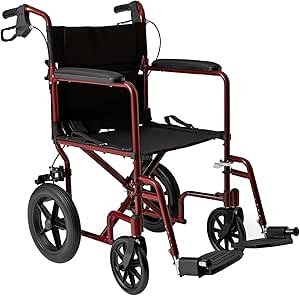
Medline Lightweight Foldable Transport Wheelchair with Handbrakes and 12-Inch Wheels, Red Frame, Black Upholstery
The 12-inch rear wheels set this Medline apart from the 8-inch wheels on the Medline Ultra Lightweight Folding Transport Wheelchair. Their larger size can make bumps and uneven pavement easier for a caregiver to manage, while the hand brakes offer added control when slowing or positioning the chair. A 19-inch seat and full-length cushioned armrests suit seniors who want a familiar, supported sitting position on outings. The tradeoff is weight: at 26 pounds, it is substantially heavier than the Ultra Lightweight model, and the listed folded height is 37.5 inches, so check trunk clearance. Like the other transport chair, this model must be pushed by someone else. I see it as the better pick for varied routes, provided lifting weight is not the main concern.
Pros:- 12-inch rear wheels handle varied surfaces more readily than small transport-chair wheels
- Hand brakes provide caregiver control while moving
- Full-length cushioned armrests and a 19-inch seat
- Folding design requires no assembly
Cons:- At 26 pounds, it is heavier to lift than the Medline Ultra Lightweight model
- Folded height of 37.5 inches may challenge some trunk spaces
- No headrest or additional support accessories are included
Best for: Caregivers taking seniors over mixed indoor and outdoor paths who value larger wheels and hand-operated braking
Not ideal for: Caregivers who frequently lift a chair into a vehicle or seniors seeking a self-propelled wheelchair
- Weight:26 lb
- Weight capacity:300 lb
- Frame:Aluminum
- Rear wheels:12 in
- Seat dimensions:19 in wide x 16 in deep
- Assembled dimensions:30.25 x 19 x 37.25 in
- Folded dimensions:30.25 x 12 x 37.5 in
- Brakes:Hand brakes and rear-wheel locking brakes
Our verdict“Pick this Medline when caregiver control and larger wheels matter more than keeping the chair especially light to lift.”
Invacare Transport Wheelchair for Adults – Compact Lightweight Foldable Chair with 19″ Seat, Seatbelt, Swing-Away Footrests
Storage space is the reason to look at this Invacare: its dual-fold design narrows to 9 inches, compared with the 12-inch folded width listed for the Medline transport chair with 12-inch wheels. That slimmer profile can help in a crowded closet or a small trunk. The 19 x 16-inch breathable nylon seat and integrated pocket add practical comfort and storage for short trips. A reinforced steel frame favors stability, but it also makes this chair heavier than the aluminum Medline options; the supplied details do not give a weight, so I would confirm lifting needs before choosing it. The 9-inch folded width still takes space, and its 8-inch casters do not offer the same larger-wheel advantage as the Medline with 12-inch rear wheels. It suits assisted travel where compact storage matters most.
Pros:- Dual-fold design reduces folded width to 9 inches
- Breathable 19 x 16-inch nylon seat
- Integrated storage pocket keeps small items close
- Three-year frame warranty
Cons:- Steel frame is heavier than aluminum alternatives, with no weight supplied
- Folded width may still be too large for very tight spaces
- 8-inch casters lack the larger-wheel advantage of the Medline 12-inch model
Best for: Families with limited closet or trunk width who need a stable caregiver-pushed chair for outings
Not ideal for: Caregivers prioritizing the lightest possible lift or seniors who regularly travel over rough outdoor paths
- Frame:Reinforced steel
- Seat dimensions:19 x 16 in
- Backrest height:39.5 in unfolded
- Folded width:9 in
- Casters:8 in TPU front and rear
- Upholstery:Breathable nylon
- Storage:Integrated pocket
- Frame warranty:3 years
Our verdict“Choose this Invacare if narrow folded storage and a stable steel frame outweigh the uncertainty about lifting weight.”
Drive Medical Folding Transport Wheelchair with Swing-Away Footrests
This Drive Medical transport chair keeps the setup straightforward for indoor use and level paths: padded armrests, a padded 17-inch nylon seat, and swing-away footrests support shorter trips and easier transfers. Its frame and backrest fold flat, which makes it practical for storage between appointments. Compared with the 19-inch-seat Medline Ultra Lightweight, however, the 17-inch seat is narrower, and the supplied specifications give no weight or folded measurements to help a caregiver judge lifting and trunk fit. The 8-inch wheels also make it a less compelling choice for uneven outdoor routes than the Medline with 12-inch rear wheels. This is a basic assisted-mobility option for seniors who spend most of their time on smooth floors; I would skip it for frequent outdoor travel.
Pros:- Frame and backrest fold flat for storage
- Swing-away footrests aid transfers
- Padded seat and armrests add cushioning
- Nylon upholstery wipes clean
Cons:- 17-inch seat is narrower than the 19-inch Medline transport options
- 8-inch wheels are less suited to rough terrain than the Medline 12-inch model
- Weight and folded dimensions are not supplied
Best for: Seniors with caregiver support who need a padded transport chair for indoor appointments and smooth, level paths
Not ideal for: People needing a wider seat, frequent rough-surface travel, or specific lifting and trunk-fit details before buying
- Frame:Steel
- Wheel size:8 in
- Seat width:17 in
- Seat material:Padded nylon
- Armrests:Padded
- Footrests:Swing-away
- Folding design:Frame and backrest fold flat
Our verdict“Pick this Drive Medical for caregiver-assisted indoor trips if its narrower seat fits and outdoor terrain is not a priority.”
Drive Medical Blue Streak Lightweight Wheelchair, Footrests, 18″ Seat
Unlike the caregiver-pushed transport chairs above, the Blue Streak is a manual wheelchair with a conventional daily-mobility setup. Its 18-inch seat, flip-back desk arms, and removable swing-away footrests give seniors more flexibility for reaching tables and transferring. The 12.5-inch folded width also makes it easier to stow than a chair that folds only at the frame. The tradeoff is the 41.3-pound listed weight: it is far heavier to lift than the aluminum Medline transport chairs, so a caregiver may find vehicle loading difficult. Solid tires avoid routine inflation but offer limited traction on rough outdoor terrain. This makes more sense for a senior who can self-propel or wants a chair for regular use than for families whose main need is the lightest possible chair to carry.
Pros:- Manual wheelchair format supports self-propulsion
- Flip-back desk arms improve access to tables and desks
- Removable swing-away footrests aid transfers
- Folds to 12.5 inches wide and uses maintenance-free solid tires
Cons:- At 41.3 pounds, it is heavy for caregivers to lift into a car
- Solid tires provide limited traction on rough terrain
- Steel frame is heavier than the aluminum transport-chair alternatives
Best for: Seniors who need a manual wheelchair for regular mobility, with desk-access arms and the ability to self-propel
Not ideal for: Caregivers seeking an easy-to-lift travel chair or users who frequently cross rough, loose outdoor surfaces
- Weight:41.3 lb
- Frame:Alloy steel
- Seat dimensions:18 in wide x 16 in deep
- Seat height:18 in
- Turn radius:12 in
- Folded width:12.5 in
- Tires:Solid
- Arms and footrests:Flip-back desk arms; swing-away removable footrests
Our verdict“Choose the Blue Streak for regular self-propelled mobility and desk access if its weight is manageable for the household.”
Lightweight Expedition Transport Wheelchair – Red
The 19 lb aluminum frame makes this the easiest chair in this group to lift into a vehicle, a meaningful advantage for caregivers who handle transport often. Its 12-inch rear wheels and curb-assist feature should roll more smoothly over small thresholds than a compact transport chair with smaller wheels, while companion-operated loop-lock brakes give the pusher control when stopping. Compared with the Medline Lightweight Foldable Transport Wheelchair with Handbrakes, this Drive model is lighter, but the Medline lists a wider 19-inch seat and a seat belt. The Expedition’s 300 lb capacity and stated limits on rough terrain narrow its fit; the simple fold and light weight matter most for routine trips on mostly level paths.
Pros:- At 19 lb, it is the lightest option among these five products.
- Aluminum frame reduces lifting burden for caregivers.
- 12-inch rear wheels and curb-assist help with small thresholds.
- Rear-lever folding mechanism simplifies storage.
Cons:- 300 lb capacity rules it out for some users.
- Not intended for very rough or uneven terrain.
- Companion-operated brakes mean the seated user cannot propel or brake it independently.
Best for: Caregivers who frequently lift a transport chair into a car and travel on smooth indoor floors or even paths
Not ideal for: Users above 300 lb or households that need a chair for rough, uneven outdoor routes
- Weight:19 lb
- Maximum load capacity:300 lb
- Frame material:Aluminum
- Rear wheel size:12 in
- Braking system:Companion-activated loop-lock hand brakes
- Folding mechanism:Rear-lever manual fold
- Color:Red
Our verdict“Choose the Expedition if low lifting weight is the priority and a caregiver will push it on mostly smooth routes.”
Drive Medical Cruiser III Lightweight Wheelchair, Full Arms, Black, 18 Inch
The Cruiser III suits seniors who need a self-propelled wheelchair with more adjustment than a basic transport model. At 36 lb, it is heavier than the Drive Medical Expedition Transport Wheelchair, but it has large rear wheels, adjustable seat height, and detachable flip-back arms—features that can support independent movement and easier side transfers. Elevating leg rests add flexibility for users who need their legs raised, while the 12-inch folded width helps with storage. The tradeoff is a carbon steel frame that takes more effort to lift than the Expedition’s aluminum one, and its 26-inch overall width may be awkward in narrow doorways. Unlike the Blue Streak 16-inch model, this chair has an 18-inch seat, but its listed dimensions still merit a doorway check.
Pros:- 36 lb weight is relatively manageable for a full-size wheelchair.
- Adjustable seat height and detachable flip-back arms support a more tailored fit and transfers.
- Elevating leg rests offer added positioning flexibility.
- Folds to 12 inches wide for storage and transport.
Cons:- Heavier than the transport chairs in this batch, including the 19 lb Expedition.
- 26-inch overall width may not clear some doorways.
- Seat has no additional cushioning for extended sitting.
Best for: Seniors who can self-propel and need adjustable seat height, flip-back arms, or elevating leg rests
Not ideal for: Caregivers who need the lightest chair for frequent lifting, or users navigating narrow doorways
- Weight:36 lb
- Weight capacity:300 lb
- Seat width:18 in
- Folded width:12 in
- Frame material:Carbon steel
- Wheel type:Mag-style wheels
- Front caster size:8 in
- Overall dimensions:42 in L x 26 in W x 35 in H
Our verdict“Pick the Cruiser III when adjustable support and self-propulsion matter more than the easiest possible lift.”
Drive Medical Blue Streak Lightweight Wheelchair, Footrests, 16″ Seat
The Blue Streak’s 16-inch seat gives it a narrower fit than the 18-inch Cruiser III or the 20-inch Medline folding wheelchair, which may suit seniors who find wider seats cumbersome. It is a full wheelchair with swing-away footrests and flip-back desk arms, so it supports self-propulsion and easier access alongside a table. Its 12.5-inch folded width helps with storage, though the 41.3 lb steel frame is a substantial lift compared with the 19 lb Expedition transport chair. Solid hard-rubber tires avoid inflation upkeep, but the product data limits its terrain suitability to smooth or level surfaces. I’d favor the Cruiser III for a lighter full-size chair with an 18-inch seat; the Blue Streak makes more sense when the 16-inch seat is the better fit.
Pros:- 16-inch seat offers a narrower fit than the 18-inch Cruiser III and 20-inch Medline.
- Swing-away footrests and flip-back desk arms can ease transfers and table access.
- Folds to 12.5 inches wide for storage.
- Solid tires require no inflation.
Cons:- At 41.3 lb, it is relatively heavy for caregivers to lift.
- Limited to smooth indoor floors or level outdoor surfaces.
- Hard rubber tires may provide less cushioning over bumps than larger transport-chair wheels.
Best for: Seniors who self-propel and need a 16-inch seat for a more compact fit at home
Not ideal for: Caregivers who frequently lift a chair into a vehicle or users who travel over rough outdoor surfaces
- Weight:41.3 lb
- Seat height:16 in
- Seat depth:16 in
- Dimensions:42 in D x 23 in W x 36 in H
- Turn radius:3 ft
- Frame material:Alloy steel
- Wheel type:Hard rubber solid tires
- Brake style:Push-to-lock
Our verdict“Choose this Blue Streak if a 16-inch seat and self-propulsion suit the user better than low chair weight.”
Medline Comfortable Folding Wheelchair with Swing-Back Desk-Length Arms and Swing-Away Footrests, 20″W x 16″D Seat
This Medline is the widest-seated choice in the five-product batch, with a 20-inch seat that may offer a more accommodating fit than the Blue Streak’s 16-inch seat or the Cruiser III’s 18-inch seat. Swing-back desk-length arms and swing-away footrests help with side transfers and positioning at a table, while the padded nylon seat adds a comfort feature absent from the Blue Streak description. It folds to 11.5 inches wide, slightly narrower than the 12-inch Cruiser III, which is useful for storage. The tradeoff for this wider fit is a 26.5-inch assembled width, so I’d check door clearances before choosing it. The data gives no chair weight, making it harder to judge against the 19 lb Expedition for caregiver lifting.
Pros:- 20-inch-wide seat offers more room than the Blue Streak 16-inch and Cruiser III 18-inch models.
- Padded nylon seat and armrests provide breathable cushioning.
- Swing-back desk-length arms and swing-away footrests support transfers and table access.
- Folds to 11.5 inches wide.
Cons:- 26.5-inch assembled width may be restrictive in narrow doorways.
- Chair weight is not provided, so lifting effort is difficult to compare.
- Requires manual propulsion.
Best for: Seniors who need a 20-inch seat, padded nylon support, and arms that swing back for transfers
Not ideal for: Caregivers who need a confirmed low chair weight or users moving through especially narrow doorways
- Weight capacity:300 lb
- Seat dimensions:20 in W x 16 in D
- Overall dimensions, assembled:32.5 in L x 26.5 in W x 36.5 in H
- Overall dimensions, folded:32.5 in L x 11.5 in W x 36.5 in H
- Frame material:High-strength hammertone steel
- Tires:Smooth, flat-free tires
- Armrests:Swing-back desk-length arms
- Footrests:Swing-away
Our verdict“Choose this Medline for its wider padded seat and transfer-friendly arms if the chair’s assembled width fits your home.”
Medline Lightweight Foldable Transport Wheelchair with Handbrakes, 12-Inch Wheels, Blue Frame and Black Upholstery
This Medline transport chair puts transfer control and a wider seat ahead of minimum carry weight. At 26 lb, its aluminum frame is heavier than the 19 lb Drive Expedition, but it adds a seat belt, handbrakes, and rear-wheel locks—a more complete safety setup for a caregiver managing stops and transfers. The 19-inch-wide cushioned seat also offers more room than the Expedition description specifies, though that makes measuring the user and available space important. Its 12-inch rear wheels help with maneuvering, and the chair folds to 12 inches wide. Like the Expedition, it depends on a caregiver to push; compared with the Cruiser III, it is far easier to lift but does not provide the same self-propelled setup.
Pros:- Seat belt, handbrakes, and rear-wheel locks support safer stops and transfers.
- Aluminum frame weighs 26 lb, lighter than the full-size Cruiser III and Blue Streak.
- 19-inch cushioned seat is wider than the Expedition’s unspecified seat.
- 12-inch rear wheels and a 12-inch folded width aid maneuvering and storage.
Cons:- At 26 lb, it weighs 7 lb more than the Drive Expedition.
- Requires a caregiver to push.
- 19-inch seat width may not fit every user or narrow route.
Best for: Caregivers who want a transport chair with a seat belt, handbrakes, and a 19-inch seat for routine outings
Not ideal for: Seniors seeking independent self-propulsion or caregivers whose top priority is the lightest possible chair
- Weight:26 lb
- Weight capacity:300 lb
- Frame material:Aluminum
- Seat dimensions:19 in W x 16 in D
- Rear wheel size:12 in
- Assembled dimensions:30.25 in L x 19 in W x 37.25 in H
- Folded dimensions:30.25 in L x 12 in W x 37.5 in H
- Upholstery:Black nylon
Our verdict“Pick this Medline when caregiver-controlled brakes and a 19-inch seat matter more than carrying the lightest chair.”
Drive Medical Silver Sport 1 Folding Transport Wheelchair, Black
The Silver Sport 1 suits seniors whose caregiver wants padded armrests and breathable upholstery in a folding transport chair. Its 37.6 lb steel frame is the heaviest specified option here, so lifting it into a car may take more effort than lifting the 30 lb Medline Folding Steel Transport Wheelchair. The tradeoff is a familiar, sturdy steel build with low-maintenance urethane tires and a folding back for storage. Removable swing-away footrests can clear the way for transfers, while push-to-lock brakes help keep the chair still during stops. This is a caregiver-pushed transport chair, not a self-propelled wheelchair; I’d choose it for comfort features over frequent lifting or independent mobility.
Pros:- Full-length padded armrests add support during seated trips.
- Breathable nylon upholstery is suited to extended sitting.
- Removable swing-away footrests make transfers easier.
- Folding back and carry pocket add practical storage and travel features.
Cons:- At 37.6 lb, it is heavier to lift than the 30 lb Medline transport chair.
- Requires a caregiver to push; it is not self-propelled.
Best for: Seniors who rely on a caregiver for outings and want padded armrests and removable footrests for transfers.
Not ideal for: Caregivers who frequently lift a chair into a vehicle, or seniors who need to propel themselves.
- Frame:Powder-coated steel
- Weight:37.6 lb
- Weight capacity:250 lb
- Upholstery:Breathable nylon
- Armrests:Full-length padded
- Footrests:Removable, swing-away
- Brakes:Push-to-lock
- Storage:Folding back and carry pocket
Our verdict“Choose the Silver Sport 1 if padded support matters more than having the lightest chair to lift.”
Medline Folding Steel Transport Wheelchair with Swing-Away Footrests, 19-Inch Seat
At 30 lb, this Medline is easier to lift than the Drive Medical Silver Sport 1, which weighs 37.6 lb, while keeping a 19-inch seat and cushioned armrests. That makes it a practical fit for families who regularly fold and load a transport chair. Its detachable, swing-away footrests help clear the sides for transfers, and the seat belt adds restraint during caregiver-pushed trips. The steel frame and 250 lb capacity are conventional rather than especially light or high-capacity, so it does not match the Drive Medical AeroFly for low carry weight or the Medline 300 lb model for stated capacity. I’d shortlist it for everyday indoor and outdoor use when manageable lifting and a roomy seat matter more than advanced mobility features.
Pros:- 30 lb product weight is lower than the Silver Sport 1’s 37.6 lb.
- 19-inch-wide seat provides room for seated trips.
- Detachable swing-away footrests ease entry, exit, and transfers.
- Folds for storage and is specified for indoor and outdoor use.
Cons:- Still weighs 30 lb, which can be difficult for some caregivers to lift repeatedly.
- 250 lb capacity is lower than the 300 lb capacity of the Medline lightweight wheelchair in this lineup.
Best for: Caregivers who load a transport chair often and want a 19-inch seat, seat belt, and detachable footrests.
Not ideal for: Buyers needing a chair for a user above 250 lb or a very low-lift-weight option like the AeroFly.
- Frame:Carbon steel with chip-resistant chrome plating
- Product weight:30 lb
- Weight capacity:250 lb
- Seat dimensions:19 in wide × 16 in deep
- Wheel size:8 in front and rear
- Folded dimensions:22.24 × 10.43 × 29.13 in
- Footrests:Swing-away and detachable
- Brakes:Push-to-lock
Our verdict“Pick this Medline for a folding transport chair that is easier to lift than the Silver Sport 1 while retaining a 19-inch seat.”
Invacare Lightweight Folding Transport Wheelchair with 19-Inch Seat
The Invacare’s defining advantage is its 9-inch folded width, which can make it easier to store in a narrow closet or fit alongside luggage. Its 19 × 16-inch seat and breathable nylon resemble the Medline Folding Steel Transport Wheelchair, but the Invacare adds a one-handed folding design, assembled delivery, and a three-year frame warranty. Swing-away footrests and a storage pocket round out the caregiver-focused setup. There is a major planning gap for anyone comparing lift effort or user fit: the supplied product data gives neither chair weight nor weight capacity. The Medline’s 30 lb weight and 250 lb capacity are explicit, so it is the clearer choice when those limits drive the decision. Choose Invacare when compact folding and warranty coverage take priority.
Pros:- Folds to a specified width of 9 inches for storage and transport.
- One-handed folding design simplifies handling.
- Arrives fully assembled and includes a storage pocket.
- Three-year frame warranty is specified.
Cons:- Product weight is not specified, so caregivers cannot assess lifting effort from the supplied data.
- Weight capacity is not specified, making user fit harder to confirm.
Best for: Caregivers with limited closet or vehicle space who want a compact-folding transport chair with a 19-inch seat.
Not ideal for: Buyers who need confirmed chair weight or weight capacity before deciding whether it suits the caregiver or user.
- Seat dimensions:19 × 16 in
- Folded width:9 in
- Folded backrest height:28.75 in
- Unfolded height:39.5 in
- Caster size:8 in, front and rear
- Frame material:Steel
- Warranty:3-year frame warranty
- Assembly:Fully assembled
Our verdict“Choose the Invacare when narrow folded storage and its frame warranty matter more than having published weight and capacity figures.”
Drive Medical AeroFly Ultra-Lite Folding Wheelchair, 20-Inch Seat, Matte Gray
The AeroFly stands apart from the caregiver-pushed transport chairs in this group: it is a folding wheelchair with rear wheels, a 20-inch seat, and a stated total weight of 20 lb with those wheels attached. Its 14 lb transport weight excludes rear wheels, anti-tippers, and footrests, so I’d use the 20 lb figure when judging the load a caregiver may need to handle in its more complete configuration. The Medline Folding Steel Transport Wheelchair weighs 30 lb, making the AeroFly the more appealing pick for frequent vehicle loading, and its 300 lb maximum recommendation exceeds that Medline’s 250 lb capacity. Quick-release wheels and dual braking add flexibility, though the specs do not say which components are included in every weighing configuration beyond the listed exclusions.
Pros:- 20 lb total weight with rear wheels attached is below the listed weights of both steel transport chairs.
- 20-inch seat and 300 lb maximum recommendation suit buyers needing more width or capacity.
- Quick-release rear wheels and carry handles support transport and storage.
- Dual braking system and anti-tippers add specified stability and stopping features.
Cons:- The 14 lb transport weight excludes rear wheels, anti-tippers, and footrests.
- More configuration details may matter when estimating the weight lifted for a specific trip.
Best for: Seniors and caregivers seeking a lower-weight folding wheelchair with a 20-inch seat and rear-wheel setup.
Not ideal for: Buyers who need the simplicity of a caregiver-pushed transport chair or who are comparing carry weights without accounting for excluded components.
- Frame material:Magnesium alloy
- Transport weight:14 lb (excluding rear wheels, anti-tippers, and footrests)
- Total weight:20 lb (with rear wheels attached)
- Seat dimensions:20 in wide × 16 in deep; 19 in seat height
- Maximum weight recommendation:300 lb
- Dimensions:30.3 in D × 26 in W × 36 in H
- Wheel size:20 in
- Features:Folding frame, fold-down backrest, quick-release rear wheels, carry handles, anti-tippers, dual braking
Our verdict“Choose the AeroFly if a lighter, rear-wheel folding wheelchair and a 20-inch seat fit your needs, using its 20 lb total weight for planning.”
Medline Lightweight Wheelchair for Adults with Swing-Back Desk-Length Arms, Elevating Leg Rests, Nylon Upholstery, Black, 20″ W x 16″ D Seat
This Medline is the comfort and positioning choice: elevating leg rests and swing-back desk-length arms support seated users who need leg elevation or closer access to a table. At 33 lb, it is lighter than the Drive Medical Silver Sport 1 transport chair, though substantially heavier than the 20 lb Drive Medical AeroFly with its rear wheels attached. Its 20-inch seat and 300 lb capacity also distinguish it from the 19-inch, 250 lb Medline transport chair. The tradeoff is a 10.5-inch folded width and a conventional wheelchair configuration, so it may take more storage room than the Invacare’s 9-inch folded width, and its lifting weight is not especially low. I’d favor it for positioning needs over compact storage or minimal carry weight.
Pros:- Elevating leg rests support users who need their legs raised while seated.
- Swing-back desk-length arms help with lateral transfers and table access.
- 20-inch seat and 300 lb capacity exceed the 19-inch, 250 lb Medline transport chair’s listed fit limits.
- 33 lb weight is lower than the Silver Sport 1’s 37.6 lb.
Cons:- At 33 lb, it is heavier to lift than the 20 lb AeroFly with rear wheels attached.
- Its 10.5-inch folded width is wider than the Invacare’s specified 9-inch folded width.
Best for: Seniors who need elevating leg rests and caregivers who want swing-back arms for transfers or table access.
Not ideal for: Caregivers who prioritize the lowest lifting weight or need the narrowest folded chair for tight storage.
- Weight:33 lb
- Maximum load capacity:300 lb
- Seat dimensions:20 in wide × 16 in deep
- Upholstery:Breathable nylon
- Overall dimensions, assembled:30 in L × 25.5–27.5 in W × 38 in H
- Overall dimensions, folded:30 in L × 10.5 in W × 38 in H
- Armrests:Swing-back, desk-length
- Leg rests:Elevating
Our verdict“Choose this Medline for elevating leg rests and transfer-friendly arms when those features matter more than the lightest lift or narrowest fold.”

How We Picked
I ranked these chairs around the decisions that most affect a senior’s daily use: whether the user or a caregiver will propel it, how the seat and footrests match the user, and how practical the chair is to fold, lift, and store. I gave conventional wheelchairs an advantage for buyers who need the option to self-propel, while transport chairs earned stronger consideration for caregiver-led trips and compact handling. Seat dimensions, arm style, wheel configuration, handbrakes, and leg-rest features helped distinguish models with otherwise similar roles.
The ranking favors versatility for the top overall pick, then gives narrower roles to options that better serve specific needs such as caregiver braking, a smaller seat, or reduced carrying weight. I treated unclear or unlisted specifications as unknown rather than assuming they were superior. A chair’s listed weight cannot settle whether it is comfortable, easy for a particular caregiver to lift, or suitable for a user’s body and mobility needs, so buyers should confirm those details with the manufacturer or a clinician when needed.
Factors to Consider When Choosing Lightweight Wheelchairs For Seniors
Before choosing a model, I would start with the way the chair will be used across a full outing: who pushes it, how the user sits and transfers, and where it needs to go when folded. These questions can rule out a poor fit before appearance or a long feature list becomes a distraction.
Choose Between Self-Propelling and Caregiver Pushing
A lightweight wheelchair can mean a self-propelled chair or a transport chair, and those designs serve different routines. Self-propelled models have larger rear wheels that let a user push independently if their strength, reach, and coordination allow it. Transport chairs use smaller wheels and are pushed by a companion, so they can suit appointments and outings where a caregiver stays with the user. A common mistake is buying a transport chair because it seems compact, then discovering the user cannot move around without help. Think about who will push on ramps and over uneven pavement, not only who will load the chair into a car. If independent movement matters, confirm the chair’s wheel setup and intended use before comparing frame weights.
Measure the User and the Tightest Passage
Seat width should be chosen for the seated user, with enough room to sit comfortably and enough support to avoid excessive side-to-side movement. Measure across the hips while seated and check the manufacturer’s sizing guidance rather than treating an 18-, 19-, or 20-inch seat as interchangeable. Then measure doorways, bathroom turns, and the narrowest path the chair must pass through. A wide seat can help fit some users but may make maneuvering at home harder. Also check seat depth and the user’s posture, since a width measurement alone does not confirm a sound fit. When the chair is for someone with changing needs, ask a clinician or seating specialist to help assess fit.
Check the Whole Loading Job
For car trips, the relevant task is lifting and stowing the folded chair, not just reading its weight on a product page. The caregiver may need to lift it from a low position, fold it quickly, remove or swing away parts, and fit it beside luggage or a mobility aid. Check folded dimensions and whether footrests detach, since two chairs with similar listed weights can pack very differently. If possible, compare the handling steps with the person who will load it regularly. A chair that is easy to push but awkward to lift can become a poor match for frequent outings. Match portability to the actual vehicle and caregiver’s lifting ability.
Match Brakes and Controls to the Caregiver
Handbrakes on some transport chairs give the person pushing a way to control speed or hold the chair in place, which may help on slopes and during stops. They do not replace the user’s wheel locks, and features vary by model, so check what each brake does and where it is operated. Consider the caregiver’s hand strength and whether controls are easy to reach while maintaining a steady grip. Families sometimes focus on wheel size without asking how the chair will be controlled during transfers or on inclines. Practice using the brakes in a safe, level setting before relying on them outdoors. For steep routes, confirm the chair’s limits and seek professional advice about safe use.
Choose Footrests for Transfers and Leg Position
Swing-away footrests can clear space for transfers, while elevating leg rests address a different need by supporting raised legs. Neither feature should be selected from the name alone: the user needs appropriate lower-leg support, and the caregiver needs to manage the hardware safely. Ask whether the footrests come off, swing aside, or need adjustment, and check how that affects storage and transfers. A standard swing-away setup may be simpler for routine outings; elevating rests can add useful positioning options when a clinician recommends them. Avoid assuming an elevating feature is automatically more comfortable for everyone. Fit and safe positioning should guide the choice.
Prioritize Routine and Upkeep Over Extra Features
Think through where the chair will be stored, how often it will be folded, and whether it will travel indoors, outdoors, or both. Upholstery, frame materials, wheel condition, and moving parts all affect ongoing care, so review the manufacturer’s cleaning and maintenance instructions before purchase. A chair with more adjustments may address a specific need but can add parts to manage during folding and transport. Conversely, a simpler chair may be easier to handle but lack a feature the user relies on for comfort or positioning. Ask about replacement parts and service support if the chair will be used every day. Paying for a feature makes sense when it solves a regular problem; otherwise, dependable fit and manageable handling deserve priority.
Frequently Asked Questions
Should I choose a transport chair or a self-propelled wheelchair for a senior?
Choose based on who needs to move the chair during ordinary use. A transport chair is built for a companion to push, while a self-propelled wheelchair gives the user large rear wheels to push if they have the strength and reach. If the senior will sometimes be alone, a caregiver-pushed chair may limit their independence. If a companion will always be present and compact handling matters, a transport model may fit better. Confirm the intended wheel setup and discuss mobility needs with a clinician when the answer is not clear.
How do I know whether a 16-, 18-, 19-, or 20-inch seat will fit?
Measure the user while seated and use the manufacturer’s fitting guidance; the number in a model name is not a substitute for checking the person’s measurements. The seat should support the hips without pinching or leaving excessive side-to-side space. Also check seat depth, arm clearance, clothing, and any cushions the user will use. A wider seat can affect maneuvering through the home, so measure tight doorways as well. Ask a seating specialist or clinician for help if the user has posture, skin, or positioning concerns.
Are handbrakes on a transport chair enough for safe use on slopes?
Handbrakes can help a caregiver control or hold some transport chairs, but their presence alone does not establish that a chair is suitable for a particular slope. Check the manufacturer’s instructions for how the brakes work and the chair’s use limits. The user’s wheel locks, caregiver technique, surface condition, and transfer plan also affect safety. Try the controls on level ground first and avoid unfamiliar inclines until the caregiver is confident. For steep routes or complex mobility needs, ask a clinician or mobility professional for guidance.
What should I check before buying a lightweight wheelchair for car trips?
Check the folded dimensions, the steps needed to fold it, and whether footrests or other parts need to be removed. Compare those details with the car’s trunk opening and the space left after other items are loaded. The person who will lift the chair should consider the actual lifting motion, since a low trunk or awkward grip can make a manageable weight difficult. If practical, arrange a demonstration or confirm the return terms before committing. A chair that fits the car and the caregiver’s routine is more useful than one selected from its listed weight alone.
When are elevating leg rests worth choosing?
Elevating leg rests may suit someone who needs their legs supported in a raised position, particularly when that setup has been recommended for their condition. They add adjustment and handling steps, and they can affect transfers and storage. For many everyday trips, swing-away footrests may be simpler if raised positioning is not needed. Ask the user’s clinician how the legs should be positioned and whether the selected chair can provide that support. Confirm the fit and adjustment instructions before relying on the feature.
Conclusion
For a versatile conventional wheelchair, I recommend the Drive Medical Blue Streak with an 18-inch seat as my best overall pick; the 16-inch Blue Streak is a better starting point for a user who needs a narrower seat, once fit is confirmed. My best value direction is a straightforward folding transport model such as the Drive Medical Silver Sport 1 for caregiver-led trips, provided its specifications suit the user and routine. For a buyer prioritizing a lower carrying weight, the AeroFly Ultra-Lite is my premium-leaning choice, though I would compare its fit and folded handling before deciding. Beginners should first settle whether the user or a companion will propel the chair, then compare the Blue Streak for self-propelling use with a simple transport chair for accompanied outings. For specific needs, the Medline transport chair with handbrakes suits caregiver control, while the Medline model with elevating leg rests is worth considering when raised leg support is needed. In every case, confirm seat fit, intended use, and safe handling before choosing.
Cold & flu season Picks
humidifiers
As an affiliate, we earn on qualifying purchases.