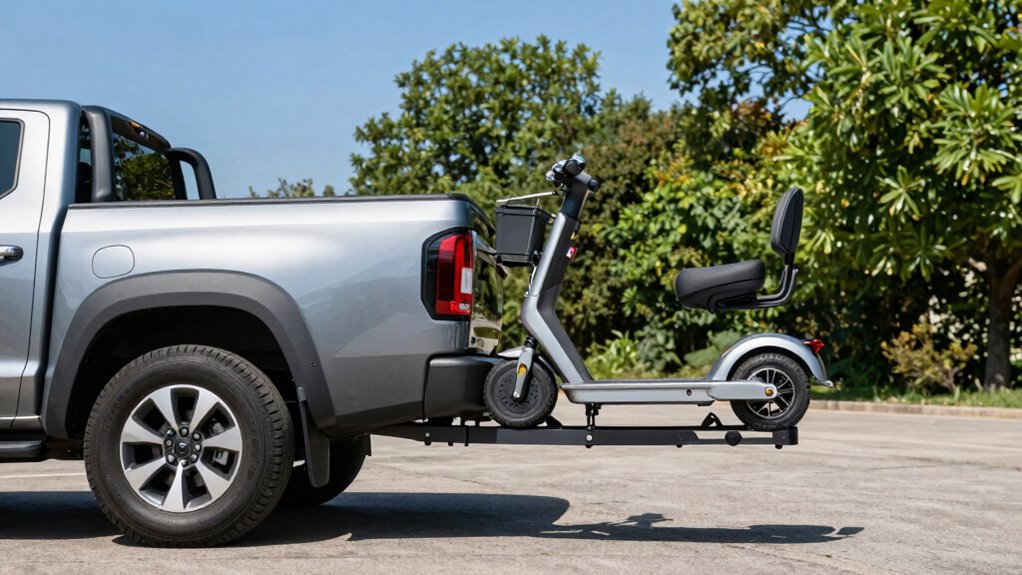

Hitch-mounted scooter lifts range from simple ramp carriers to powered platforms, and my best overall pick is the Silver Spring Tilt-A-Rack for buyers who want a tilt feature and a 350-pound capacity. For higher-capacity ramp loading, the VEVOR 500-pound aluminum carrier stands out, while the Silver Spring electric carrier suits buyers who want powered loading. The main tradeoffs are manual versus powered loading, carrier weight and material, rated capacity, and how much clearance the loaded platform needs. A lift that fits the scooter but exceeds the vehicle’s hitch or payload limits is not a safe match. Read on for the full breakdown of all 13 options and a guide to choosing by vehicle, scooter, and loading needs.

Turn quiet afternoons into listening time
- Thousands of audiobooks, podcasts and originals
- Listen on your phone, tablet or Echo — also offline
- Cancel anytime
Complete the kit


Key Takeaways
- The lineup splits into ramp carriers and powered lifts: ramp models rely on the user or a helper to roll the scooter aboard, while electric models reduce that effort but add system complexity.
- Rated capacity varies across the named products: the Silver Spring Tilt-A-Rack and electric carrier are listed at 350 pounds, while several ramp carriers are listed at 500 pounds; match the rating to the fully loaded scooter.
- The VEVOR model’s aluminum construction sets it apart from the steel-heavy options: material can affect carrier weight and handling, but buyers still need to check the complete assembly’s rating and vehicle limits.
- Ramp length and platform dimensions matter as much as capacity: extra-long and folding ramps can help with approach angle and storage, but a larger carrier can add substantial length behind the vehicle.
- Receiver compatibility is a deciding filter, not a minor detail: the AL100HD listing calls out a II/III hitch adapter, while the VEVOR listing specifies a 2-inch receiver; confirm the exact fit before choosing any carrier.




| hitch mounted scooter lift | Material |
|---|---|
| ECOTRIC Hitch Mount Wheelchair | Alloy steel |
| Wheelchair Scooter Carrier wit | Aluminum and powder-coated steel |
| Mobility Scooter Carrier Tilt- | Aluminum |
| ALMULOO Hitch Mount Carrier wi | Steel |
| AL100HD Universal Scooter Lift | Alloy steel |
| KUAFU Trailer Hitch Folding Mo | Steel |
| Electric Hitch-Mounted Carrier | — |
| VEVOR Hitch Mount Wheelchair C | Aluminum |
| Silver Spring Electric Mobilit | Aluminum |
| ECOTRIC 46.2 x 26.8 x 38.7 Inc | Heavy-duty steel |
| Wheelchair Scooter Carrier for | Alloy steel |
| Heavy Duty Steel Wheelchair an | Steel |
| Hitch-Mounted Mobility Carrier | Powder-coated steel |
More Details on Our Top Picks
ECOTRIC Hitch Mount Wheelchair Carrier with Mobility Ramp
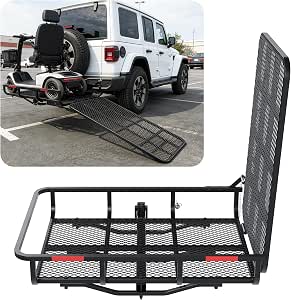
For buyers carrying a scooter alongside other bulky equipment, the ECOTRIC stands out for its 500 lb capacity and 11 tie-down points, which offer more attachment choices than the Silver Spring Wheelchair Scooter Carrier’s unspecified tie-down layout. Its steel basket and 3-inch safety rail suit loads that benefit from a defined edge, while the included ramp avoids needing to lift a mobility device onto the platform. The tradeoff is handling: at 73 lb, it is substantially heavier than Silver Spring’s 56 lb carrier, so mounting or storing it alone may be difficult. The broad basket can also obstruct rear visibility, and fit is limited to vehicles with a Class III or IV 2-inch receiver. I’d choose it for secure, heavy loads, not frequent solo installation.
Pros:- 500 lb stated capacity suits many mobility devices and heavier equipment.
- 11 tie-down points give flexible options for securing different load shapes.
- Integrated ramp supports loading without lifting the scooter onto the basket.
- Steel construction, powder-coated finish, and a 3-inch safety rail provide a substantial cargo platform.
Cons:- At 73 lb, it can be awkward to install, remove, or store without help.
- Requires a Class III or IV 2-inch hitch, excluding vehicles without that receiver.
- Its wide, projecting basket may interfere with rear visibility when mounted.
Best for: Owners of a truck, SUV, or van with a Class III or IV 2-inch hitch who need multiple tie-down positions for a heavy scooter or mixed equipment load.
Not ideal for: Drivers who need a lighter carrier to install alone, have a smaller hitch receiver, or frequently rely on an unobstructed view behind the vehicle.
- Load capacity:500 lb
- Carrier weight:73 lb
- Dimensions:44.75 x 31.75 x 6 in
- Ramp dimensions:29.75 x 42.5 in
- Material:Alloy steel
- Finish:Black powder-coated
- Hitch fit:Class III or IV, 2-inch receiver
- Tie-down points:11
- Safety rail height:3 in
Our verdict“Choose the ECOTRIC if you want a 500 lb steel carrier with numerous tie-down points and can manage its weight and rear-visibility footprint.”
Wheelchair Scooter Carrier with Ramp for Car, Truck, SUV – 500 lb Capacity, Silver Spring
The Silver Spring combines a 500 lb capacity with a 56 lb carrier weight, making it the more manageable choice beside the 73 lb ECOTRIC and ALMULOO steel carriers. Its aluminum-and-steel construction and folding ramp target buyers who want a substantial loading platform without as much carrier weight to handle. The 48 x 27.75-inch inner basket gives a clear measure of the usable area, useful when checking a scooter’s footprint before buying. It still needs a Class III or IV 2-inch receiver, and 56 lb is not light enough to make solo installation easy for everyone. The product details also do not specify weather or rust protection, unlike the ECOTRIC’s stated powder-coated finish. I’d favor it when carrier weight matters more than a documented protective finish.
Pros:- 500 lb capacity serves buyers who need more headroom than the 350 lb Tilt-A-Rack.
- At 56 lb, it weighs less than the ECOTRIC and ALMULOO carriers.
- Foldable ramp, side rails, and tie-down points support loading and cargo restraint.
- Published inner basket dimensions help buyers compare the bed with their scooter.
Cons:- Fit is limited to Class III or IV 2-inch receivers.
- Its 56 lb weight can still make installation and removal difficult for one person.
- The supplied details do not specify weather resistance or rust-proofing.
Best for: Mobility-device owners with a Class III or IV 2-inch receiver who want a 500 lb ramp carrier that weighs less than the heavier steel-basket alternatives.
Not ideal for: Buyers who need a small-vehicle hitch fit, want a stated rust-resistant finish, or cannot safely handle a 56 lb carrier.
- Weight capacity:500 lb
- Carrier weight:56 lb
- Material:Aluminum and powder-coated steel
- Inner basket:48 x 27.75 in
- Outer basket:48 x 28 in
- Ramp:45.625 x 27.75 in
- Hitch fit:Class III or IV, 2-inch receiver
Our verdict“Pick this Silver Spring carrier if you need a 500 lb ramp platform but want less carrier weight than the steel ECOTRIC or ALMULOO.”
Mobility Scooter Carrier Tilt-A-Rack by Silver Spring, 350 lb Capacity
The Tilt-A-Rack takes a different approach from the fixed-bed ECOTRIC and Silver Spring 500 lb carrier: its tilt design and sliding ramp are intended to make loading access more adaptable, including from either side. That flexibility may suit owners whose parking setup makes one loading direction inconvenient. Its aluminum platform also avoids the steel construction used by the higher-capacity basket options. The main compromise is capacity: at 350 lb, it offers less headroom than either 500 lb carrier, so buyers need to check the scooter’s weight carefully. The listed item weight is 120 lb, which makes the “lightweight” material description no guarantee of easy handling. It folds for storage and includes an anti-rattle device, but the product details flag possible assembly or fit issues.
Pros:- Tilt design and sliding ramp allow loading access from either side.
- Aluminum construction distinguishes it from the steel ECOTRIC and ALMULOO baskets.
- Foldable platform helps when storage space is limited.
- Anti-rattle device and adjustable hitch adapter are included.
Cons:- 350 lb capacity is lower than the 500 lb ECOTRIC and Silver Spring basket carriers.
- Listed item weight of 120 lb can make installation and handling challenging.
- Product details note possible assembly or fit issues and provide limited warranty information.
Best for: Scooter owners under the 350 lb capacity limit who need a sliding-ramp carrier with tilt access and have a compatible 2-inch receiver.
Not ideal for: Owners of heavier mobility devices or anyone prioritizing a low carrier weight, straightforward assembly, or more fully documented warranty details.
- Weight capacity:350 lb
- Item weight:120 lb
- Platform dimensions:52 x 27.625 in
- Item dimensions:52.75 x 27.75 x 12 in
- Material:Aluminum
- Hitch fit:Class III or IV, 2-inch receiver
- Loading features:Tilt design and sliding ramp
Our verdict“Choose the Tilt-A-Rack for its tilt-and-slide loading access if your scooter is within 350 lb and you can handle a heavy carrier.”
ALMULOO Hitch Mount Carrier with Folding Ramp for Wheelchairs and Lawn Equipment
ALMULOO’s defining difference is its flat-bed-to-L-position conversion, giving it more setup flexibility than the fixed basket layout of the ECOTRIC Hitch Mount Wheelchair Carrier. That can appeal to buyers who want a carrier for both a mobility device and occasional lawn equipment, rather than a single-purpose loading surface. The steel frame, 500 lb capacity, folding ramp, and mounting hardware make it a substantial option, while reflective tape adds visibility to the carrier. Its 73 lb weight is the same as the ECOTRIC’s, so that flexibility comes with the same practical installation burden. The supplied bed is 29.75 x 43.75 inches with a 5-inch depth; buyers should compare those measurements with their equipment. Fit is restricted to full-size vehicles with a Class III or IV 2-inch hitch.
Pros:- Converts between flat-bed and L-position configurations.
- 500 lb capacity and steel construction support substantial cargo.
- Folding ramp allows equipment to be rolled onto the bed.
- Mounting hardware and reflective tape are included.
Cons:- At 73 lb, it may be difficult to install or reposition alone.
- Specified fit is limited to full-size vehicles with a Class III or IV 2-inch hitch.
- The 29.75 x 43.75-inch bed may not suit every scooter or equipment footprint.
Best for: Full-size vehicle owners who want a 500 lb steel carrier that can switch between a flat bed and an L-position for different equipment.
Not ideal for: People seeking a lightweight carrier, a smaller hitch fit, or a platform with less setup and installation complexity.
- Load capacity:500 lb
- Unit weight:73 lb
- Bed dimensions:29.75 x 43.75 in
- Bed depth:5 in
- Ramp length:42.5 in
- Material:Steel
- Hitch fit:Class III or IV, 2-inch hitch; specified for most full-size vehicles
- Configuration:Flat bed or L-position
Our verdict“Choose ALMULOO over the fixed-layout ECOTRIC if changing between flat-bed and L-position configurations matters more than ease of handling.”
AL100HD Universal Scooter Lift Outside Fully Automatic Carrier with II/III Hitch Adapter
Unlike the ramp-and-basket carriers in this group, the AL100HD is a fully automatic scooter lift: its powered operation is aimed at reducing the effort of loading and unloading, rather than relying on a user to guide a device up a ramp. The 400 lb capacity sits between the 350 lb Tilt-A-Rack and the 500 lb ECOTRIC and Silver Spring carriers, so it offers more capacity than the former but less than the latter. Its adjustable cradle extends to 46 inches, and the hold-down foot design avoids requiring scooter modifications. The Class II/III adapter may fit a different range of receivers than the Class III/IV basket carriers, but buyers still need to confirm vehicle and hitch suitability. It costs storage space too: the 27.5 x 39-inch platform is not a compact accessory.
Pros:- Fully automatic operation reduces manual loading and unloading effort.
- 400 lb capacity exceeds the Tilt-A-Rack’s 350 lb limit.
- Hold-down foot design avoids requiring modifications to the scooter.
- Adjustable cradle extends to 46 inches, with a manual override included.
Cons:- Capacity is below the 500 lb ECOTRIC and Silver Spring carriers.
- Requires a compatible Class II or III hitch installation.
- The 27.5 x 39-inch platform can be cumbersome to store.
Best for: Scooter owners who want powered loading and unloading, need capacity up to 400 lb, and have a vehicle compatible with its Class II/III hitch adapter.
Not ideal for: Buyers seeking a simple ramp carrier, carrying a scooter above 400 lb, or needing a compact platform for storage.
- Capacity:400 lb
- Platform size:27.5 x 39 in
- Cradle extension:Up to 46 in
- Hitch adapter:Class II/III
- Material:Alloy steel
- Finish:Powder-coated
- Pull force:400 lb
- Operation:Fully automatic, with manual override
Our verdict“Choose the AL100HD if powered loading matters more than maximum capacity and your vehicle is compatible with its Class II/III adapter.”
KUAFU Trailer Hitch Folding Mobility Scooter Carrier Rack Luggage Basket Lift Rack Loading Ramp Wheelchair Carrier Mount Steel
The KUAFU is a strong match for buyers who prioritize a 500 lb capacity and a steel platform over a lighter carrier. Its 38.7-inch folding ramp and three-position folding design support loading mobility devices or other bulky cargo, then tucking the rack into a less obtrusive position. Compared with the aluminum VEVOR Hitch Mount Wheelchair Carrier, KUAFU uses heavier steel and weighs 75 pounds, so it may suit buyers who favor a steel build but is less appealing to anyone installing or removing a carrier alone. The safety rail adds a boundary around the load, but the rack still needs proper stabilization: a hitch tightener is not included, and poor installation can allow wobble. Choose it for a compatible 2-inch receiver and a high-capacity ramp carrier, not for quick, tool-free setup.
Pros:- 500 lb capacity accommodates heavier mobility devices and cargo.
- 38.7-inch folding ramp supports roll-on loading.
- Three-position folding design offers storage flexibility.
- Steel construction and a 3-inch safety rail help contain the load.
Cons:- 75-pound rack can be difficult to handle during installation.
- Hitch tightener is required for added stability but is not included.
- Limited to 2-inch Class III or IV receivers.
Best for: Owners of Class III or IV vehicles with a 2-inch receiver who need a high-capacity steel carrier for a scooter, wheelchair, or occasional heavy cargo.
Not ideal for: Drivers with smaller or non-2-inch receivers, or buyers who need a lighter rack that one person can install without extra stabilization hardware.
- Material:Steel
- Weight capacity:500 lbs
- Ramp length:38.7 inches
- Ramp weight:16 lbs
- Total weight:75 lbs
- Hitch compatibility:2-inch receiver, Class III or IV
- Safety rail:3 inches
- Folding positions:3
Our verdict“Choose the KUAFU if you want a steel 500 lb ramp carrier and can supply the stabilizer and compatible hitch setup.”
Electric Hitch-Mounted Carrier Lift for Mobility Scooters
For buyers who want to avoid pushing a scooter up a ramp, this powered carrier offers a different approach from the KUAFU Trailer Hitch Folding Mobility Scooter Carrier and its manual roll-on loading. The lift raises a compatible mobility device in about 20 seconds and folds in roughly six, with one-key control for routine operation. Its aluminum platform and steel frame support up to 350 pounds, while four self-tensioning retractors and a warning LED add useful load-management details. The platform folds flat against the vehicle, which can reduce how far the carrier protrudes when it is idle. That convenience comes with limits: it requires a Class II or higher hitch, and the manual backup crank may be strenuous for someone with limited upper-body strength. Compared with the heavier-duty 500 lb VEVOR carrier, this is the pick for powered loading, not maximum capacity.
Pros:- Powered lift raises the carrier load in about 20 seconds.
- Folds against the vehicle in about six seconds.
- Four self-tensioning retractors and a warning LED support secure transport.
- Manual backup crank provides an alternative if powered operation is unavailable.
Cons:- 350 lb capacity is below the 500 lb VEVOR and KUAFU carriers.
- Class II-or-higher hitch requirement rules out some vehicles.
- Backup crank may be difficult for users with limited upper-body strength.
Best for: Scooter owners who want powered loading and folding, have a Class II-or-higher hitch, and can manage the backup crank if needed.
Not ideal for: Buyers with mobility devices over 350 pounds, vehicles without a suitable hitch, or users unable to operate the manual backup crank.
- Platform material:High-strength aluminum
- Frame material:Steel
- Weight capacity:350 lbs
- Platform dimensions:38 x 27.5 inches
- Cradle extension:Up to 46 inches
- Lift time:20 seconds
- Fold time:6 seconds
- Hitch compatibility:Class II or higher
- Included features:Four self-tensioning retractors, license plate holder, manual backup hand crank, warning LED light, one-key control
Our verdict“Pick this powered carrier if avoiding ramp loading matters more than the higher capacity offered by manual 500 lb racks.”
VEVOR Hitch Mount Wheelchair Carrier, 500 lbs Capacity with Folding Ramp, Aluminum Cargo Rack for 2″ Receiver
The VEVOR combines a 500 lb capacity with an aluminum frame, making it a useful middle ground between heavy steel racks and powered lifts with lower capacity. At 52.3 pounds, it is lighter than the 75-pound KUAFU and 67.3-pound ECOTRIC, although it may still take two people to position and fit. The 50 x 29.5-inch platform provides room for a range of mobility devices, and the folding ramp makes loading possible without a powered mechanism. An anti-wobble stabilizer, reflectors, and tie-down hooks come with the carrier, giving it a more complete setup than the ECOTRIC, which lacks an included anti-wobble plate. The tradeoff is fit and use: it needs a 2-inch receiver, and the listed transport speed limit is 55 mph. Buyers should also plan for careful installation despite its lower weight.
Pros:- 500 lb capacity suits many scooters, wheelchairs, and cargo loads.
- At 52.3 pounds, it is lighter than the listed KUAFU and ECOTRIC carriers.
- Aluminum construction resists corrosion.
- Includes folding ramp, tie-down hooks, reflectors, and anti-wobble stabilizer.
Cons:- Requires a 2-inch receiver.
- The stated maximum transport speed is 55 mph.
- Its 52.3-pound weight may still require help during installation.
Best for: Owners of 2-inch receivers seeking a 500 lb ramp carrier that is lighter than the KUAFU or ECOTRIC and includes a stabilizer.
Not ideal for: Drivers without a 2-inch hitch, buyers seeking powered loading, or anyone who cannot accommodate the stated 55 mph transport limit.
- Load capacity:500 lbs
- Material:Aluminum
- Dimensions:50 x 29.5 x 8.9 inches
- Weight:52.3 lbs
- Receiver size:2 inches
- Color:Silver
- Included features:Folding ramp, reflectors, tie-down hooks, anti-wobble stabilizer
- Maximum transport speed:55 mph
Our verdict“Choose the VEVOR for a lighter 500 lb manual carrier with a stabilizer, provided its receiver and speed limits fit your use.”
Silver Spring Electric Mobility Scooter Carrier for Car, SUV, 350 lb Capacity
The Silver Spring electric carrier suits buyers whose vehicle has a Class II, III, or IV receiver and who want powered loading in a relatively narrow 350 lb category. Its 39 x 27-inch platform and 46-inch extended cradle provide room for compatible mobility devices, while the vertical-folding design can reduce the carrier’s footprint when it is not in use. Compared with the Electric Hitch-Mounted Carrier Lift, it shares the 350 lb capacity and electric format, but the available product details here do not specify operating times or list retractors, warning lights, or a backup crank. Its 82-pound weight is also a real handling concern, even though it is made from aluminum. Buyers should check installation hardware requirements before ordering, since no hardware is included. This option is best judged by hitch-class flexibility, not by a lighter or more fully documented feature set.
Pros:- Compatible with Class II, III, and IV hitch receivers.
- 350 lb capacity accommodates many mobility scooters and power chairs.
- Vertical-folding design reduces the carrier’s footprint when stored.
- Aluminum construction offers a lighter material than the steel KUAFU and ECOTRIC.
Cons:- At 82 pounds, it is heavier than the listed manual VEVOR carrier.
- Installation hardware is not included.
- Product details do not specify lift time or several safety accessories listed for the other electric lift.
Best for: Owners of Class II, III, or IV vehicles with a mobility device within 350 pounds who want an electric carrier with vertical folding.
Not ideal for: People who need to install the carrier alone, buyers whose device exceeds 350 pounds, or anyone who requires included installation hardware.
- Hitch compatibility:Class II, III, IV
- Capacity:350 lbs
- Platform size:39 x 27 inches
- Extended cradle:46 inches
- Material:Aluminum
- Weight:82 lbs
- Design:Electric carrier with vertical-folding storage
- Installation hardware:Not included
Our verdict“Choose the Silver Spring if its broad hitch-class compatibility and electric lift match your vehicle and device, and you can arrange installation help.”
ECOTRIC 46.2 x 26.8 x 38.7 Inch Hitch Cargo Carrier with Ramp, Foldable, 500 lbs Capacity
The ECOTRIC is a straightforward choice for drivers who want a steel ramp carrier without paying for an electric mechanism. Its 500 lb rating matches the KUAFU and VEVOR, and its 46.2 x 26.8-inch platform gives buyers a defined loading area for a scooter or wheelchair. The 38.7-inch ramp folds for storage, while the black powder-coated finish is intended to resist corrosion. At 67.3 pounds, it is lighter than the KUAFU but heavier than the aluminum VEVOR, so it sits between them on handling rather than leading the group. Unlike the VEVOR, the ECOTRIC does not include an anti-wobble plate, meaning buyers may need to source extra stabilization. It also requires a 2-inch Class III or IV hitch, and the ramp’s 16-pound weight can make handling awkward. Do not load it while anyone is seated on the mobility device.
Pros:- 500 lb capacity matches the KUAFU and VEVOR carriers.
- 38.7-inch folding ramp supports roll-on loading and storage.
- Powder-coated steel construction is suited to heavy-duty cargo use.
- At 67.3 pounds, it is lighter than the KUAFU steel carrier.
Cons:- No anti-wobble plate is included.
- The 16-pound ramp may be awkward to lift and position.
- Limited to 2-inch Class III or IV receivers.
Best for: Drivers with a 2-inch Class III or IV hitch who need a 500 lb steel ramp carrier for occasional scooter, wheelchair, or equipment transport.
Not ideal for: Buyers who need built-in anti-wobble hardware, a lighter aluminum rack, powered loading, or a carrier compatible with smaller hitch classes.
- Platform size:26.8 x 46.2 inches
- Ramp length:38.7 inches
- Carrier weight:67.3 lbs
- Ramp weight:16 lbs
- Maximum load capacity:500 lbs
- Material:Heavy-duty steel
- Finish:Black powder-coated
- Receiver compatibility:2-inch hitch, Class III or IV
Our verdict“Pick the ECOTRIC for a simple 500 lb steel ramp rack if you can add stabilization and handle its heavy ramp.”
Wheelchair Scooter Carrier for Car Truck SUV, Extra Long Ramp, 500 lb Cap
I’d put the Titan Ramps MC500 on the shortlist when a gentler approach to loading matters more than keeping the carrier light. Its 60-inch folding ramp is longer than the 42-inch ramp on the Heavy Duty Steel Wheelchair and Scooter Carrier, which can make pushing a mobility device aboard less steep. The 500-pound capacity also exceeds that model’s 400-pound limit. A mesh basket lets water and debris fall through, while the ramp can fold vertically for travel or lie flat in the basket. The tradeoff is substantial: at 80 pounds, this is a demanding carrier to position and install, and its overall length calls for attention to rear clearance. I’d choose it over the shorter-ramp alternatives for loading access, not for easier handling.
Pros:- 60-inch ramp offers a longer loading approach than the 42-inch ramp on the Heavy Duty Steel Wheelchair and Scooter Carrier.
- 500-pound rated capacity supports heavier mobility devices and equipment.
- Mesh basket allows rain, snow, and debris to pass through.
- Folds at the hitch to reduce its footprint when not carrying a load.
Cons:- 80-pound carrier may be difficult for one person to lift and install.
- Long overall dimensions can complicate parking and require careful clearance checks.
- Requires a Class III or IV 2-inch hitch receiver.
Best for: Scooter or wheelchair owners who need a longer loading ramp, have a compatible 2-inch Class III or IV hitch, and can get help handling an 80-pound carrier.
Not ideal for: Solo installers or drivers with limited rear clearance who want a lighter, shorter carrier that is easier to maneuver.
- Brand:Titan Ramps
- Model:MC500
- Load capacity:500 pounds
- Material:Alloy steel
- Carrier weight:80 pounds
- Ramp length:60 inches
- Basket dimensions:47.5 x 28 x 4.375 inches
- Hitch compatibility:Class III or IV, 2-inch receiver
Our verdict“Choose the Titan Ramps MC500 if a long loading ramp and 500-pound capacity matter more to you than manageable installation weight.”
Heavy Duty Steel Wheelchair and Scooter Carrier with Folding Ramp
This carrier’s standout is its three-position folding ramp: the ramp can be set for loading, held upright, or stored, giving owners more options for access and parking than the simpler fold-up setup described for the Titan Ramps MC500. Its 48 x 28-inch platform gives a clear footprint for a mobility device, and the powder-coated steel construction is suited to regular outdoor transport. The main compromise is capacity: its 400-pound limit is lower than the 500-pound ratings of both the Titan MC500 and the Hitch-Mounted Mobility Carrier Ramp. Its 42-inch ramp is also shorter than Titan’s 60-inch version, so loading may be steeper. I’d favor this model when ramp positioning is useful and the device’s loaded weight fits its lower rating.
Pros:- Three ramp positions provide loading, upright support, and storage options.
- 48 x 28-inch platform provides a defined space for mobility equipment.
- Powder-coated steel construction is suited to outdoor use.
- Fits standard 2-inch Class III or IV hitch receivers.
Cons:- 400-pound capacity is lower than the 500-pound Titan Ramps MC500 and Hitch-Mounted Mobility Carrier Ramp.
- 42-inch ramp is shorter than the Titan MC500’s 60-inch ramp.
- Heavy steel construction may take effort to install.
Best for: Owners of mobility devices under 400 pounds who want several ramp positions for loading, storage, and access at the rear of a vehicle.
Not ideal for: Buyers with heavier scooters or those who need a longer, gentler ramp or a receiver other than a 2-inch Class III or IV hitch.
- Material:Steel
- Finish:Powder coated
- Weight capacity:400 pounds
- Upright size:48 x 28 x 42 inches
- Platform dimensions:48 x 28 inches
- Extended ramp length:42 inches
- Hitch compatibility:Class III or IV, 2-inch receiver
Our verdict“Pick this carrier if its 400-pound limit suits your equipment and adjustable ramp positioning matters more than maximum capacity or ramp length.”
Hitch-Mounted Mobility Carrier Ramp, 46.2 x 26.8 x 38.7 inches, 500 lbs Capacity
The Hitch-Mounted Mobility Carrier Ramp pairs a 500-pound capacity with a more compact stated size than the Titan Ramps MC500, making it a plausible fit for buyers who want substantial carrying capacity without that model’s 107.5-inch overall length. Its foldable, multi-position ramp is designed to support loading and improve access when the carrier is not in its travel position. Powder-coated steel gives it a sturdy build, and locking mechanisms are included for transport. The listing recommends professional installation, and the unit weighs 75 pounds, so this is not the easiest choice for someone who needs to install or remove a carrier alone. Compared with the 400-pound Heavy Duty Steel carrier, it offers more rated capacity; compared with Titan’s longer ramp, the available specs don’t state a ramp length, so I can’t rank its loading angle as confidently.
Pros:- 500-pound capacity matches the Titan Ramps MC500 and exceeds the 400-pound Heavy Duty Steel carrier.
- Foldable ramp has multiple positions for loading and transport.
- Stated dimensions are more compact than the Titan MC500’s overall length.
- Locking mechanisms are included for secure transport.
Cons:- 75-pound weight and recommendation for professional installation can make setup difficult.
- Ramp length is not provided, limiting comparison of loading angle with the Titan MC500.
- Compatible only with vehicles using a 2-inch hitch receiver.
Best for: SUV, truck, or van owners who need a 500-pound-rated carrier with a foldable ramp and have access to help with installation.
Not ideal for: Buyers who need a specified long ramp, have a hitch other than a 2-inch receiver, or want a lightweight carrier for frequent solo removal.
- Dimensions:46.2 x 26.8 x 38.7 inches
- Load capacity:500 pounds
- Material:Powder-coated steel
- Carrier weight:75 pounds
- Hitch size:2 inches
- Ramp:Foldable, multiple positions
- Transport security:Locking mechanisms included
Our verdict“Choose this model for a 500-pound rating and foldable ramp in a shorter stated footprint, provided you can arrange installation help.”

How We Picked
I compared these 13 hitch-mounted carriers and lifts on the details buyers need to match before purchase: stated load capacity, loading method, platform and ramp design, construction material, receiver fit, and whether the lift is manual or powered. Those factors affect safety, loading effort, vehicle compatibility, and day-to-day practicality. I also separated dedicated mobility carriers from listings with broader cargo or equipment language, since that wording can make it less clear whether a product is designed around a scooter’s dimensions and tie-down needs.
The ranking gives priority to clear, decision-relevant specifications and useful loading features, not a claim that one carrier fits every vehicle. Ramp carriers rank well for simpler operation and lower system complexity; powered lifts earn attention for reducing manual handling, but buyers must verify their electrical and receiver requirements. Models with a stated 350-pound capacity are not interchangeable with the 500-pound options, and a carrier’s rating does not replace checking the vehicle’s tongue-weight limit, hitch rating, scooter dimensions, and loaded weight. Where listing details leave fit or operation unclear, I treat that uncertainty as a reason to verify before buying rather than assume compatibility.
| hitch mounted scooter lift | Material |
|---|---|
| ECOTRIC Hitch Mount Wheelchair | Alloy steel |
| Wheelchair Scooter Carrier wit | Aluminum and powder-coated steel |
| Mobility Scooter Carrier Tilt- | Aluminum |
| ALMULOO Hitch Mount Carrier wi | Steel |
| AL100HD Universal Scooter Lift | Alloy steel |
| KUAFU Trailer Hitch Folding Mo | Steel |
| Electric Hitch-Mounted Carrier | — |
| VEVOR Hitch Mount Wheelchair C | Aluminum |
| Silver Spring Electric Mobilit | Aluminum |
| ECOTRIC 46.2 x 26.8 x 38.7 Inc | Heavy-duty steel |
| Wheelchair Scooter Carrier for | Alloy steel |
| Heavy Duty Steel Wheelchair an | Steel |
| Hitch-Mounted Mobility Carrier | Powder-coated steel |
Factors to Consider When Choosing Hitch Mounted Scooter Lifts
Before choosing among these hitch-mounted scooter lifts, work from the vehicle and scooter outward: confirm what the hitch can carry, how the scooter will reach the platform, and how the carrier affects access and clearance. These checks often matter more than a headline capacity.
Start With Total Weight and Vehicle Limits
Calculate the weight of the scooter with its battery and any accessories, then add the carrier’s weight to understand the load acting on the hitch. Compare that figure with the vehicle’s tongue-weight limit and the hitch and carrier ratings; use the lowest applicable limit. A carrier marked for 500 pounds does not raise a vehicle’s own limit. Also check the owner’s manual for restrictions on hitch-mounted loads, since a long platform places weight behind the axle and can affect handling. Buyers often focus only on scooter weight and miss the carrier’s contribution. If the numbers leave little margin, ask the vehicle or hitch manufacturer for guidance before choosing a model.
Match Loading Style to the Person Doing the Loading
A ramp carrier is mechanically straightforward, but someone still needs to guide the scooter up the incline and secure it on the platform. Ramp length, surface, and the scooter’s ground clearance all affect how manageable that task feels. A shorter ramp may take less room to store but create a steeper approach; a longer ramp can ease the angle while needing more space during loading. Powered lifts reduce the need to push a scooter up a ramp, but they bring electrical connections, controls, and more components to understand. Decide who will load the scooter and how independently they need to do it before choosing between manual and powered equipment.
Check Platform Size, Scooter Footprint, and Tie-Down Points
Compare the platform’s usable width and length with the scooter’s full footprint, including tiller, wheels, and any parts that extend during loading. Listings may show overall carrier dimensions rather than clear usable deck space, so ask the seller for platform measurements when they are missing. Leave room to position straps or other restraints without placing them against fragile controls or body panels. A scooter that fits between the platform edges can still be difficult to secure if tie-down access is awkward. Check how the ramp connects and stows as well, since a ramp that shifts or blocks access can complicate loading even when the deck is large enough.
Verify Receiver Fit and Rear Clearance
Confirm the receiver size and any adapter required, then check the carrier’s fit against the hitch’s class and the vehicle manufacturer’s load limits. An adapter can make a physical connection possible, but it does not automatically make the combination suitable for the load. Measure the distance from the receiver to the vehicle’s rear body and compare it with the carrier’s platform position. Added length can affect departure angle, parking, backup sensors, rear cameras, and access to a tailgate or hatch. If the vehicle sits low or has a short rear overhang, check loaded ground clearance on a ramp or driveway transition. A driveway test with the empty carrier can reveal clearance problems before the scooter is aboard.
Choose Materials With Handling and Maintenance in Mind
Steel and aluminum involve a tradeoff between construction and handling; neither material alone establishes a carrier’s strength or suitability. The complete product rating, welds, joints, ramp attachment, and stated maintenance guidance matter more than a material label. A heavy carrier can be difficult to install or remove when it is not carrying a scooter, so think about where it will be stored and who will handle it. Ask whether the platform folds or tilts and whether those features can be operated safely with the carrier installed. Inspect exposed surfaces and moving parts periodically, especially after travel in wet or road-salt conditions. Choose based on the entire assembly and care requirements, not assumptions about one material.
Know When Powered Operation Is Worth the Added Complexity
A powered lift can make regular loading more manageable when pushing a scooter up a ramp is difficult or no helper is available. That convenience may come with extra electrical setup, controls, wiring, and components that need inspection. Before choosing one, confirm how it connects to the vehicle, what power source it needs, and whether the seller provides clear installation and operating instructions. Consider what happens if power is unavailable and whether the scooter can be unloaded safely in that situation. For occasional transport, a ramp model may be easier to maintain and store. For frequent use or limited lifting ability, powered operation may justify the extra setup when the fit and backup procedure are clear.
Frequently Asked Questions
Can I choose a 500-pound carrier if my scooter weighs much less?
A higher carrier capacity can provide useful headroom, but it does not make the setup safe by itself. Add the carrier’s weight to the scooter and accessories, then compare the total with the vehicle’s tongue-weight limit and hitch rating. The lowest limit in the full setup governs. Also check that the platform fits the scooter and that restraints can secure it properly. If the vehicle limit is unclear, check its manual or consult the hitch manufacturer before buying.
How do I know whether a ramp carrier will be manageable for me?
Think about the scooter’s weight, the loading ramp’s length and angle, and who will guide the scooter up the ramp. A longer ramp may create a gentler approach, but it can take more space to deploy and store. Check whether the scooter can be pushed safely in neutral and whether the person loading can control it on an incline. If that task is not practical, a powered lift may be a better direction, provided its electrical setup and manual recovery method are clear. Do not rely on capacity alone to judge loading effort.
Will a hitch-mounted lift fit a vehicle with a 2-inch receiver?
Not automatically: a 2-inch receiver is only one part of the fit check. Confirm that the carrier is designed for that receiver size, note whether an adapter is required, and verify the hitch’s load rating and the vehicle’s tongue-weight limit. Then check how far the loaded platform extends behind the vehicle and whether it blocks sensors, a rear camera, or a hatch. The VEVOR listing specifies a 2-inch receiver, while the AL100HD listing mentions a II/III adapter, but buyers should still confirm the exact configuration for their vehicle. Ask the manufacturer or seller if the listing does not state the fit clearly.
Is an electric carrier a better choice than a ramp carrier for independent loading?
It can be, particularly when pushing a scooter up an incline is difficult, but powered operation does not remove every loading task. The user may still need to position the scooter, operate controls, and secure it once it is on the platform. Check the lift’s power connection, installation instructions, and what to do if the electrical system fails. A ramp carrier has fewer powered components but demands more physical control during loading. The best choice depends on the person’s mobility, the scooter’s weight, and whether the operating steps can be completed safely.
What measurements should I take before ordering a carrier?
Measure the scooter’s length and width at its widest points, including parts that remain in place for travel, then compare those figures with the carrier’s usable platform dimensions. Record the vehicle’s receiver size, hitch rating, tongue-weight limit, and the distance from the receiver to the rear body. Check the vehicle manual for limits on hitch-mounted accessories and consider clearance on driveways and ramps. Also account for the carrier’s weight and the room needed to deploy its ramp or tilt feature. If a listing gives only overall dimensions, request usable deck measurements before placing an order.
Conclusion
For the best overall balance, I’d start with the Silver Spring Tilt-A-Rack if its 350-pound rating and tilt design suit the scooter and vehicle. The best value direction is a straightforward ramp carrier such as the ECOTRIC or KUAFU, after confirming platform fit, rated capacity, and receiver compatibility. For buyers who want less manual ramp loading, the best premium-style choice is the Silver Spring electric carrier; the AL100HD is another powered option to investigate when its adapter and installation details match the vehicle. Beginners who want a simpler mechanism may prefer a clearly specified folding-ramp model, such as the VEVOR, but should verify dimensions and safe tie-down points first. For a heavier scooter or a gentler loading approach, compare the 500-pound listings and the extra-long-ramp option against the vehicle’s limits rather than choosing by capacity alone. My final choice would be the model that fits the complete vehicle-and-scooter setup, not simply the one with the largest rating.