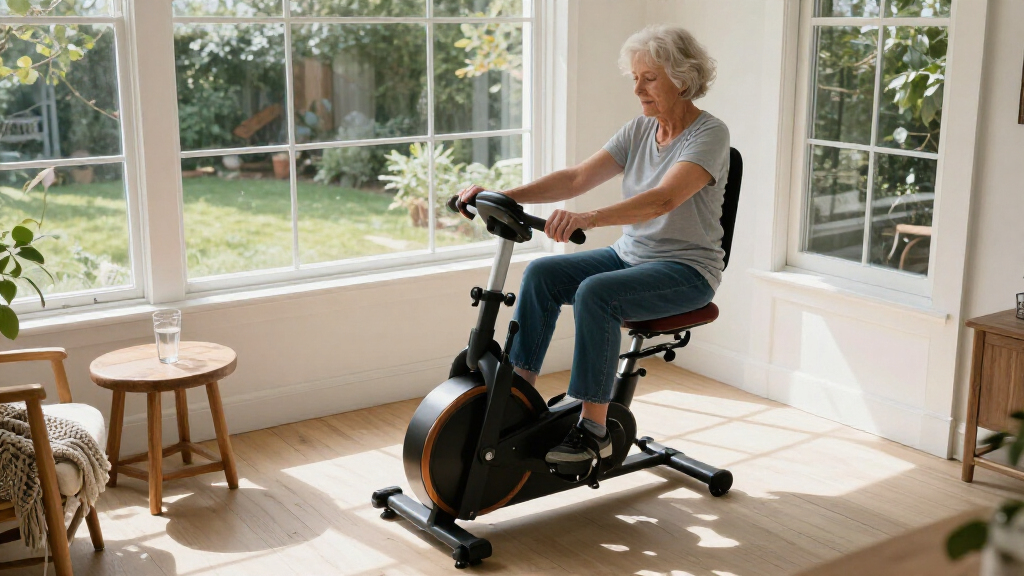

For most older adults seeking steady, low-impact exercise at home, I’d start with the JLL E110S Seated Magnetic Elliptical: its seated format may feel more approachable than a full-size rower or standing elliptical. The XVGVSV Recumbent Exercise Bike is another strong option for buyers who prioritize a supported riding position, while the Sunny Health & Fitness Compact Hydraulic Rower suits people who want a smaller rowing machine with adjustable resistance. The main tradeoffs are how much balance and coordination an exercise asks of you, how easily you can get on and off, and how much room the machine takes up. Read on for the full breakdown of all 11 picks and help matching a machine to your needs.

Give the gift of listening to someone you love
- Choose a 1-, 3-, 6- or 12-month membership
- They pick the audiobooks they love
- Easy to send by email
Complete the kit


Key Takeaways
- Seated designs lead for approachable access: The JLL E110S, XVGVSV recumbent bike, and Sunny Health & Fitness Elite Recumbent Cross Trainer keep exercise seated, though their movement patterns and space needs differ.
- Rowers ask more of the whole body: YOSUDA, YPOO, MERACH, and the Sunny rowers involve repeated leg drive and torso movement, which may be a better fit for buyers comfortable with coordinated motion.
- Compactness comes with tradeoffs: The Sunny hydraulic rower and BARWING folding bike appeal where storage matters, but a smaller footprint does not automatically mean easier access or a more comfortable fit.
- Resistance systems shape the feel: Magnetic options make up much of this lineup, while the Sunny hydraulic rower uses a different resistance approach; compare adjustment range and movement comfort rather than relying on level counts alone.
- More features do not guarantee a better match: The THERUN elliptical and Sunny Elite cross trainer offer different full-body movement options, but a simpler seated bike may suit buyers who value straightforward mounting and operation.
| YOSUDA Magnetic Rowing Machine with 16-Level Resistance |  | Best Rowing Machine for Progressive Training | Resistance: 16 magnetic levels | Maximum user weight: 350 lb | Recommended user height: 4’5″–5’11” | VIEW LATEST PRICE | See Our Full Breakdown |
| Sunny Health & Fitness Smart Magnetic Rower |  | Best for Guided Workouts and Storage | Resistance: 16 magnetic levels | Rail length: 45.7 in | Slide-rail inseam: 40.9 in | VIEW LATEST PRICE | See Our Full Breakdown |
| ANCHEER Foldable Magnetic Elliptical Trainer, 16-Inch Stride, 16 Resistance Levels |  | Best for Standing, Low-Impact Cardio | Stride length: 16 in | Resistance: 16 magnetic levels | Pedal angles: 5°, 10°, and 16° | VIEW LATEST PRICE | See Our Full Breakdown |
| JLL E110S Seated Magnetic Elliptical Trainer |  | Best Seated Cardio Option | Resistance: 8 magnetic levels | Maximum stride length: 10.6 in | Maximum recommended user weight: 100 kg | VIEW LATEST PRICE | See Our Full Breakdown |
| BARWING 5-in-1 Foldable Magnetic Resistance Exercise Bike |  | Best Compact Bike for Flexible Positions | Resistance: 16 magnetic levels | Flywheel: 6.6 lb | Maximum user weight: 350 lb | VIEW LATEST PRICE | See Our Full Breakdown |
| YPOO RM930 Magnetic Rowing Machine with 16 Resistance Levels |  | Best Fold-Away Rower | Resistance: 16-level magnetic | Maximum user capacity: 350 lb | Rail length: 46 in | VIEW LATEST PRICE | See Our Full Breakdown |
| Sunny Health & Fitness Compact Hydraulic Rower with 12-Level Resistance |  | Best Lightweight Rowing Pick | Resistance: 12 levels of hydraulic resistance | Dimensions: 58.1 × 20.1 × 24.8 in | Machine weight: 22.4 lb | VIEW LATEST PRICE | See Our Full Breakdown |
| XVGVSV Recumbent Exercise Bike for Home |  | Best for Supportive Seated Cardio | Type: Recumbent stationary exercise bike | Resistance: 16 levels of magnetic resistance | Weight capacity: 400 lb | VIEW LATEST PRICE | See Our Full Breakdown |
| THERUN Elliptical Exercise Machine with 18 lb Flywheel and 16 Resistance Levels |  | Best Standing Elliptical | Flywheel weight: 18 lb | Resistance levels: 16 | Stride length: 15 in | VIEW LATEST PRICE | See Our Full Breakdown |
| Sunny Health & Fitness Elite Recumbent Cross Trainer |  | Best Seated Full-Body Trainer | Resistance levels: 16 | Workout programs: 24 | User weight capacity: 300 lb | VIEW LATEST PRICE | See Our Full Breakdown |
| MERACH Q1S Magnetic Rowing Machine with Dual Slide Rail |  | Best Rowing Machine for Stability | Resistance mechanism: Magnetic | Resistance levels: 16 | Weight capacity: 350 lbs | VIEW LATEST PRICE | See Our Full Breakdown |
| home cardio machines for senior | Warranty | Resistance | Maximum user weight |
|---|---|---|---|
| YOSUDA Magnetic Rowing Machine | 1 year | 16 magnetic levels | 350 lb |
| Sunny Health & Fitness Smart M | 3 years on structural frame; 180 days on other parts and components | 16 magnetic levels | 300 lb |
| ANCHEER Foldable Magnetic Elli | Lifetime | 16 magnetic levels | 550 lb |
| JLL E110S Seated Magnetic Elli | 3 years on structural frame; 180 days on other parts and components | 8 magnetic levels | — |
| BARWING 5-in-1 Foldable Magnet | 1-year parts warranty | 16 magnetic levels | 350 lb |
| YPOO RM930 Magnetic Rowing Mac | 12 months | 16-level magnetic | — |
| Sunny Health & Fitness Compact | 3 years for structural frame; 180 days for other parts and components | 12 levels of hydraulic resistance | 220 lb |
| XVGVSV Recumbent Exercise Bike | — | 16 levels of magnetic resistance | — |
| THERUN Elliptical Exercise Mac | 2 years | — | 286 lb |
| Sunny Health & Fitness Elite R | 3 years on structural frame; 180 days on other parts and components | — | — |
| MERACH Q1S Magnetic Rowing Mac | — | — | — |
More Details on Our Top Picks
YOSUDA Magnetic Rowing Machine with 16-Level Resistance
The YOSUDA makes sense for seniors who want a seated, low-impact workout that can gradually become more challenging. Its 16 magnetic resistance levels offer finer adjustments than the JLL E110S seated elliptical’s eight, while rowing engages both the upper and lower body. The magnetic system and PU rollers are designed for quiet movement, a practical fit for shared homes. A 350-pound capacity also exceeds the Sunny Health & Fitness Smart Magnetic Rower’s 300-pound limit. The tradeoff is fit: YOSUDA recommends it for users from 4’5" to 5’11", so taller buyers should check that range carefully. It also needs a defined floor area, and the one-year warranty is shorter than the Sunny rower’s structural-frame coverage.
Pros:- Sixteen magnetic resistance levels allow gradual changes in workout difficulty.
- Quiet glide system and PU rollers are designed for smooth home use.
- 350-pound maximum weight capacity is higher than the Sunny Smart Magnetic Rower’s.
- LCD metrics and Bluetooth app support provide workout tracking options.
Cons:- Recommended user height stops at 5’11”, limiting fit for taller users.
- The 2.9-square-foot footprint still requires a dedicated workout area.
- One-year warranty coverage is shorter than the Sunny Smart Magnetic Rower’s frame warranty.
Best for: Seniors within the recommended height range who want quiet, adjustable, full-body rowing and a higher stated weight capacity.
Not ideal for: People taller than 5’11” or anyone who needs a machine that can be tucked away upright after each workout.
- Resistance:16 magnetic levels
- Maximum user weight:350 lb
- Recommended user height:4’5″–5’11”
- Dimensions:59 x 19 x 25 in
- Footprint:2.9 sq. ft.
- Monitor metrics:Time, distance, total count, count, and calories
- Connectivity:Bluetooth app support
- Warranty:1 year
Our verdict“Choose the YOSUDA for adjustable, quiet rowing and a 350-pound capacity if its recommended height range fits.”
Sunny Health & Fitness Smart Magnetic Rower
For a senior who wants rowing plus a way to clear floor space between sessions, the Sunny Smart Magnetic Rower has a useful combination: upright storage, transport wheels, and Bluetooth app connection. Its belt drive and dual rails are designed for quiet, steady movement, while the monitor reports more detail than the YOSUDA’s listed display, including stroke rate and 500-meter split. Sunny also provides a three-year structural-frame warranty, compared with YOSUDA’s one-year warranty. Resistance changes are manual, though, so adjusting effort means reaching for the tension knob rather than relying on an electronic control. The 40.9-inch slide-rail inseam may also limit fit for some users. I’d favor this over the YOSUDA when storage and guided app workouts matter more than a higher weight capacity.
Pros:- Upright storage and transport wheels help free floor space between workouts.
- Bluetooth connects to the SunnyFit app for guided sessions and progress tracking.
- Monitor includes stroke rate and 500-meter split alongside basic workout metrics.
- Three-year structural-frame warranty is longer than the YOSUDA’s stated coverage.
Cons:- Resistance must be adjusted manually with a tension knob.
- The 40.9-inch slide-rail inseam may not suit every user’s stride.
- Its 300-pound weight capacity is lower than the YOSUDA’s 350-pound capacity.
Best for: Seniors who want app-guided rowing, detailed stroke metrics, and upright storage in a shared or multipurpose room.
Not ideal for: Taller users who need more rail travel, or buyers who want resistance adjustments without turning a manual knob.
- Resistance:16 magnetic levels
- Rail length:45.7 in
- Slide-rail inseam:40.9 in
- Maximum user weight:300 lb
- Monitor metrics:Time, distance, estimated calories, stroke count, total strokes, strokes per minute, and 500-meter split
- Connectivity:Bluetooth
- Storage:Upright storage
- Warranty:3 years on structural frame; 180 days on other parts and components
Our verdict“Pick the Sunny Smart Magnetic Rower if guided app workouts and upright storage matter more than a higher capacity or effortless resistance changes.”
ANCHEER Foldable Magnetic Elliptical Trainer, 16-Inch Stride, 16 Resistance Levels
The ANCHEER is the standing-cardio choice in this group, pairing a 16-inch stride with magnetic resistance and adjustable pedal angles. Those pedal settings give users a way to change foot position, while the foldable frame and transport wheels help when the machine needs to be moved or stored. Compared with the seated JLL E110S, this elliptical calls for standing balance and more active movement; it may suit seniors who are comfortable exercising upright, but not those who need a seated workout. Its 550-pound stated capacity is substantially higher than the JLL’s 100 kg recommendation. That capacity does not make it a small machine: the listed footprint is 44 x 24 inches, so it needs a clear area when in use, and assembly is required.
Pros:- Sixteen-inch stride supports standing elliptical movement without the impact of running.
- Three pedal-angle settings allow foot-position adjustments.
- 550-pound listed weight capacity is higher than the JLL E110S’s 100 kg recommendation.
- Foldable frame and transport wheels support moving and storage.
Cons:- Standing exercise may not suit seniors who need a seated, supported workout.
- The 44 x 24-inch listed footprint requires substantial clear floor space while in use.
- Assembly is required before use.
Best for: Seniors comfortable standing during exercise who want a low-impact elliptical with adjustable pedal angles and a high stated weight capacity.
Not ideal for: People who need seated support, have difficulty with balance, or lack room for a 44 x 24-inch machine during workouts.
- Stride length:16 in
- Resistance:16 magnetic levels
- Pedal angles:5°, 10°, and 16°
- Flywheel:8 kg
- Maximum user weight:550 lb
- Footprint:44 x 24 in
- Monitor metrics:Time, speed, distance, calories, odometer, and pulse
- Design:Foldable with transport wheels
- Warranty:Lifetime
Our verdict“Choose the ANCHEER if you can exercise standing and want an adjustable-stride-style elliptical motion, but favor the JLL for seated support.”
JLL E110S Seated Magnetic Elliptical Trainer
The JLL E110S stands apart from the standing ANCHEER elliptical by putting the workout in a seated position, which may be a better match for seniors who prefer support while exercising. Its adjustable padded seat, pulse sensors, and forward or reverse pedaling make the session more adaptable than a basic pedal-only machine. The tradeoff is a narrower training range: it has eight resistance levels, half the number offered by the YOSUDA rower or BARWING bike, and its maximum stride is 10.6 inches. The listed maximum user weight is 100 kg, so buyers should check that limit before choosing it. At 45.1 x 26 x 60.2 inches, it is not as compact as its seated design might suggest, and its component warranty is limited to 180 days.
Pros:- Seated design offers supported cardio compared with the standing ANCHEER elliptical.
- Adjustable padded seat helps accommodate different seating positions.
- Forward and reverse pedaling add movement options.
- Pulse sensors and LCD display track heart rate and workout data.
Cons:- Eight resistance levels offer fewer adjustments than the YOSUDA rower or BARWING bike.
- Maximum recommended user weight is 100 kg.
- The 10.6-inch maximum stride is shorter than the ANCHEER’s 16-inch stride.
Best for: Seniors who want supported, seated cardio with an adjustable padded seat, pulse sensors, and forward or reverse pedaling.
Not ideal for: People above the 100 kg weight recommendation, those seeking a longer stride, or buyers who need compact storage.
- Resistance:8 magnetic levels
- Maximum stride length:10.6 in
- Maximum recommended user weight:100 kg
- Dimensions:45.1 x 26 x 60.2 in (D x W x H)
- Display size:4.8 cm
- Display metrics:Time, speed, distance, calories, pulse, SPM, and odometer
- Power source:Battery powered
- Warranty:3 years on structural frame; 180 days on other parts and components
Our verdict“Choose the JLL E110S for seated, supported cardio if its 100 kg limit, short stride, and larger-than-expected dimensions fit your needs.”
BARWING 5-in-1 Foldable Magnetic Resistance Exercise Bike
The BARWING is the space-conscious bike pick for seniors who want a choice between upright and reclined riding, plus a fold-away position when the workout is over. Its stated storage footprint is about 1.8 square feet, notably less than the YOSUDA rower’s 2.9-square-foot footprint, though the two figures describe different machine setups and should not be treated as a direct size comparison. Sixteen magnetic resistance levels and included bands add options beyond pedaling alone. The less-than-20-dB noise claim may also appeal in a shared home. Fit runs in the opposite direction from the YOSUDA: BARWING recommends riders from 4’11" to 6’6". It is only 70% pre-assembled, however, and the folded dimensions are not provided, making storage planning less certain.
Pros:- Upright, reclined, and folded positions offer more posture flexibility than the YOSUDA rower.
- Approximately 1.8-square-foot stated storage footprint supports compact storage.
- Sixteen magnetic resistance levels and exercise bands provide varied workout options.
- 350-pound capacity and a recommended height range extending to 6’6″.
Cons:- Recommended for users from 4’11” to 6’6″, excluding shorter riders outside that range.
- The machine is only 70% pre-assembled and requires further assembly.
- Folded dimensions are not provided, so storage fit is harder to verify.
Best for: Seniors who want a foldable bike with upright and reclined riding options, resistance bands, and a small stated storage footprint.
Not ideal for: People shorter than 4’11”, buyers who want a fully assembled machine, or anyone who needs exact folded dimensions before planning storage.
- Resistance:16 magnetic levels
- Flywheel:6.6 lb
- Maximum user weight:350 lb
- Recommended user height:4 ft 11 in to 6 ft 6 in
- Seat adjustment:8 height settings and 2 angle settings
- Workout positions:Upright, reclined, and folded
- Noise level:Less than 20 dB
- Storage footprint:Approximately 1.8 sq. ft.
- Warranty:1-year parts warranty
Our verdict“Pick the BARWING if you want flexible seated riding positions and compact storage, provided its height range and assembly needs work for you.”
YPOO RM930 Magnetic Rowing Machine with 16 Resistance Levels
For seniors who prefer rowing and need a machine that can be put away, the YPOO RM930 pairs 16 quiet magnetic resistance levels with vertical storage and transport wheels. Its steel frame has a higher listed capacity than the Sunny Health & Fitness Compact Hydraulic Rower, making it the more accommodating of these two rowing picks by user weight. The magnetic system operates below 25 dB, which may suit shared living spaces better than a louder workout setup.
The tradeoff is the rowing position: it requires repeated leg drive and coordinated pulling, so it may be less comfortable than the XVGVSV Recumbent Exercise Bike for someone who wants back support while exercising. The 46-inch rail also comes with a stated height range, and guided sessions depend on using a compatible app or tablet. I’d choose it for adjustable, storable rowing—not for seated, low-effort pedaling.
Pros:- Sixteen magnetic resistance levels allow workout effort to be adjusted.
- Steel frame is rated for users up to 350 lb.
- Folds for vertical storage and has transport wheels.
- LCD tracks workout metrics and the rower supports YPOOFIT and Kinomap.
Cons:- The 46-inch rail and specified height range may not fit every user.
- Rowing calls for coordinated leg and arm movement, which may not suit someone seeking supported, easy-entry exercise.
- Guided workouts require a compatible app or tablet.
Best for: Seniors who want quiet, adjustable rowing, have room to exercise but need to store the machine vertically, and fall within the listed height range.
Not ideal for: People who need a back-supported seat, prefer simple pedaling, are outside the stated 4 ft 5 in to 6 ft 3 in height range, or do not want app-guided workouts.
- Resistance:16-level magnetic
- Maximum user capacity:350 lb
- Rail length:46 in
- User height range:4 ft 5 in to 6 ft 3 in
- Noise level:Less than 25 dB
- Monitor metrics:Time, SPM, distance, calories, count
- App compatibility:YPOOFIT, Kinomap
- Storage:Vertical
- Warranty:12 months
Our verdict“Choose the RM930 if you want a quiet rower with substantial resistance adjustment and vertical storage, and can comfortably use its rowing position.”
Sunny Health & Fitness Compact Hydraulic Rower with 12-Level Resistance
At 22.4 lb, the Sunny Health & Fitness Compact Hydraulic Rower is easier to reposition than the heavier YPOO RM930, a practical distinction for a small room or a user who cannot leave equipment set up. It has 12 resistance settings, padded contact points and adjustable foot straps, with an LCD meter and Bluetooth connection to SunnyFit for basic workout tracking. Its 58.1-inch length gives the rower a relatively small overall footprint.
The main compromise is its 220 lb maximum user weight, well below the YPOO’s 350 lb rating. Its inclined rail also makes the leg drive more demanding, so the compact build does not automatically make workouts gentler. Hydraulic resistance and an app-connected display may appeal to someone who wants a simple, movable rower, but the XVGVSV Recumbent Exercise Bike is a better match for buyers who prioritize supported seated exercise over rowing movement.
Pros:- Lightweight 22.4 lb frame is easier to move than the YPOO RM930.
- Twelve resistance levels provide some adjustment to workout effort.
- Padded seat, foam-covered handlebars and adjustable foot straps support contact and positioning.
- LCD meter and Bluetooth-linked SunnyFit app provide workout tracking.
Cons:- 220 lb maximum user weight is lower than the YPOO RM930’s 350 lb rating.
- Inclined rail makes the leg drive more demanding.
- Hydraulic rowing movement may be a poor fit for seniors seeking supported, low-impact seated pedaling.
Best for: Seniors in smaller homes who want a light, easy-to-reposition rower and are within its 220 lb user limit.
Not ideal for: Users above 220 lb, or anyone who finds an inclined rowing stroke too demanding and would rather exercise with a back-supported seat.
- Resistance:12 levels of hydraulic resistance
- Dimensions:58.1 × 20.1 × 24.8 in
- Machine weight:22.4 lb
- Maximum user weight:220 lb
- Frame material:Steel
- Display metrics:Time, count, total count, calories, scan
- Connectivity:Bluetooth
- App compatibility:SunnyFit
- Warranty:3 years for structural frame; 180 days for other parts and components
Our verdict“Pick this rower for a small space and easy repositioning if its weight limit and inclined rowing stroke suit you.”
XVGVSV Recumbent Exercise Bike for Home
The XVGVSV Recumbent Exercise Bike is the clearest fit here for seniors who want to pedal while leaning against a backrest. Its padded, lever-adjustable seat and 400 lb capacity distinguish it from the Sunny Health & Fitness Elite Recumbent Cross Trainer, which adds moving handles and programs but has a lower listed capacity. Sixteen levels of quiet magnetic resistance let riders vary effort without changing the seated format, while transport wheels can help with repositioning.
It arrives 85% pre-assembled, though the remaining setup is listed at about 30 minutes, so it is not ready to ride straight out of the box. The LCD includes pulse readings from handle sensors, but the description provides no dimensions or stated warranty to help judge room fit and long-term coverage. The product description also inconsistently calls it an elliptical; I would treat the specified recumbent bike type as the relevant detail. Skip it if you want standing exercise or active upper-body movement.
Pros:- Padded seat with ergonomic backrest supports a reclined riding position.
- 400 lb stated capacity exceeds the Sunny Health & Fitness Elite Recumbent Cross Trainer’s 300 lb rating.
- Sixteen quiet magnetic resistance levels offer adjustable effort.
- Arrives 85% pre-assembled and includes front transport wheels.
Cons:- Some assembly remains; typical setup is listed at about 30 minutes.
- The product description inconsistently refers to an elliptical, creating uncertainty about the listing.
- Dimensions and warranty are not provided in the supplied product data.
Best for: Seniors who want back-supported pedaling, an adjustable seat and a high stated user capacity.
Not ideal for: People who want a standing elliptical, moving handles for upper-body exercise, or clear product information about dimensions and warranty before buying.
- Type:Recumbent stationary exercise bike
- Resistance:16 levels of magnetic resistance
- Weight capacity:400 lb
- Seat:Padded with ergonomic backrest; lever-adjustable
- Assembly:85% pre-assembled; setup typically takes 30 minutes
- Display:LCD showing speed, time, distance, calories, odometer and heart rate
- Heart rate monitoring:Handle pulse sensors
- Mobility:Front transport wheels
Our verdict“Choose this bike if back-supported pedaling and a 400 lb stated capacity matter more than upper-body movement or detailed listing information.”
THERUN Elliptical Exercise Machine with 18 lb Flywheel and 16 Resistance Levels
For seniors who prefer to exercise standing rather than pedal from a seat, the THERUN Elliptical offers a 15-inch stride, textured pedals and 16 magnetic resistance levels. Its stated noise level is below 20 dB, and the monitor tracks pulse alongside time, speed, distance, calories and odometer—useful if you want workout feedback without relying only on an app. Compared with the seated Sunny Health & Fitness Elite Recumbent Cross Trainer, THERUN asks more of balance and standing comfort, but it avoids that model’s seated-only format.
The tradeoff is its 92 lb machine weight: transport wheels help, yet moving it may still take effort. The listing gives a user height range of 4 ft 11 in to 6 ft 5 in and a 286 lb user limit, so fit matters. Although the center bar folds, no folded dimensions are supplied, making storage planning less certain than with the vertically storable YPOO RM930. I’d pass if standing stability or frequent relocation is a concern.
Pros:- Sixteen magnetic resistance levels and an 18 lb flywheel support varied workouts.
- Below-20 dB stated noise level may suit shared living spaces.
- Textured pedals provide a slip-resistant surface.
- Monitor displays pulse and several workout metrics; center bar folds and transport wheels are included.
Cons:- At 92 lb, the machine may be difficult for one person to move.
- Folded dimensions are not specified, limiting storage planning.
- Standing exercise may not suit users who need a seated, back-supported position.
Best for: Seniors who are comfortable exercising while standing and want a quiet elliptical with a built-in pulse display.
Not ideal for: People who need seated back support, have difficulty with standing balance, exceed the stated weight or height range, or need precise folded-storage dimensions.
- Flywheel weight:18 lb
- Resistance levels:16
- Stride length:15 in
- Maximum user weight:286 lb
- User height range:4 ft 11 in to 6 ft 5 in
- Machine weight:92 lb
- Noise level:Below 20 dB
- Monitor displays:Time, speed, distance, calories, odometer and pulse
- Warranty:2 years
Our verdict“Pick THERUN for standing elliptical workouts if you have the balance, space and help needed to manage a 92 lb machine.”
Sunny Health & Fitness Elite Recumbent Cross Trainer
The Sunny Health & Fitness Elite Recumbent Cross Trainer is the most versatile seated option in this group: its pedals and moving handles can be used together or separately, allowing a rider to focus on legs, arms or both. That gives it a broader workout choice than the XVGVSV Recumbent Exercise Bike, which centers on seated pedaling and back support. A step-through frame, adjustable seat and handles, cushioned seat and mesh backrest help tailor the riding position, while 24 programs and 16 resistance levels add structure.
That flexibility costs space. At roughly 71.7 × 33.3 inches at the base, it has a much larger footprint than either compact rower here, and it is designed for seated workouts rather than standing elliptical motion. Its 300 lb capacity is also below XVGVSV’s stated 400 lb. Bluetooth connects it to SunnyFit, but buyers prioritizing a small footprint or a simpler bike may prefer the smaller recumbent option. I’d choose this model when seated upper-body movement and program variety justify dedicating room to it.
Pros:- Moving handles and pedals support combined or separate upper- and lower-body workouts.
- Step-through frame, adjustable seat and handles, cushioned seat and mesh backrest support a tailored seated position.
- Sixteen resistance levels and 24 workout programs provide structured workout choices.
- Bluetooth connects to the free SunnyFit app; transport wheels and adjustable levelers are included.
Cons:- Large footprint of approximately 71.7 × 33.3 × 50.8 in requires dedicated space.
- 300 lb capacity is lower than the XVGVSV Recumbent Exercise Bike’s stated 400 lb.
- Seated design will not suit buyers who want a standing elliptical workout.
Best for: Seniors who want seated cardio with the option to work arms and legs together or separately, and have room for a full-size machine.
Not ideal for: People with limited floor space, those seeking standing elliptical exercise, or users who need a capacity above 300 lb.
- Resistance levels:16
- Workout programs:24
- User weight capacity:300 lb
- Inseam range:Approximately 30.1–39.6 in
- Dimensions:Approximately 71.7 × 33.3 × 50.8 in
- Watt control range:50–250 W
- Heart rate control:60–220 BPM
- Connectivity:Bluetooth
- Warranty:3 years on structural frame; 180 days on other parts and components
Our verdict“Choose the Elite Recumbent Cross Trainer if you want adaptable seated arm-and-leg exercise and can accommodate its larger footprint.”
MERACH Q1S Magnetic Rowing Machine with Dual Slide Rail
For seniors who want a seated, low-impact workout that recruits both arms and legs, the MERACH Q1S stands out for its dual slide rails and quiet magnetic resistance. The paired rails are designed to steady the seat as it moves, a useful distinction from simpler rowing setups, while 16 resistance levels allow gradual changes in effort. App compatibility adds workout tracking and guided course options, though using them requires a separate phone or tablet. Compared with the JLL E110S Seated Magnetic Elliptical Trainer, this rower involves more coordinated movement and a longer reach, so it may suit people seeking a fuller rowing motion rather than seated pedaling. The tradeoff is that rowing still requires repeated bending and pulling, and its 65-inch frame needs room during use. It folds for storage, but setup takes about 30 minutes.
Pros:- Dual slide rails are designed to provide a steadier seat path.
- Quiet magnetic resistance offers 16 levels for adjusting workout effort.
- MERACH and KINOMAP compatibility supports workout tracking and guided sessions.
- Folding design and built-in wheels make storage and repositioning easier.
Cons:- The rowing stroke requires repeated bending and pulling, which may not suit every senior.
- A phone or tablet for app features is not included.
- Battery power requires two batteries, and assembly takes about 30 minutes.
Best for: Seniors comfortable with rowing motion who want quiet, adjustable resistance, added seat stability, and app-based workout tracking at home.
Not ideal for: People with limited space for a 65-inch machine, difficulty bending or coordinating a rowing stroke, or a preference for seated pedaling over full-body movement.
- Resistance mechanism:Magnetic
- Resistance levels:16
- Weight capacity:350 lbs
- User height limit:6 ft 5 in
- Dimensions:65 L × 19.3 W × 24.8 H in
- Product weight:42 lbs
- App compatibility:MERACH, KINOMAP
- Recommended storage space:1.6 × 2.1 ft
Our verdict“Choose the MERACH Q1S if you want an adjustable, relatively quiet rower with added seat stability and have room for its full-length workout footprint.”
How We Picked
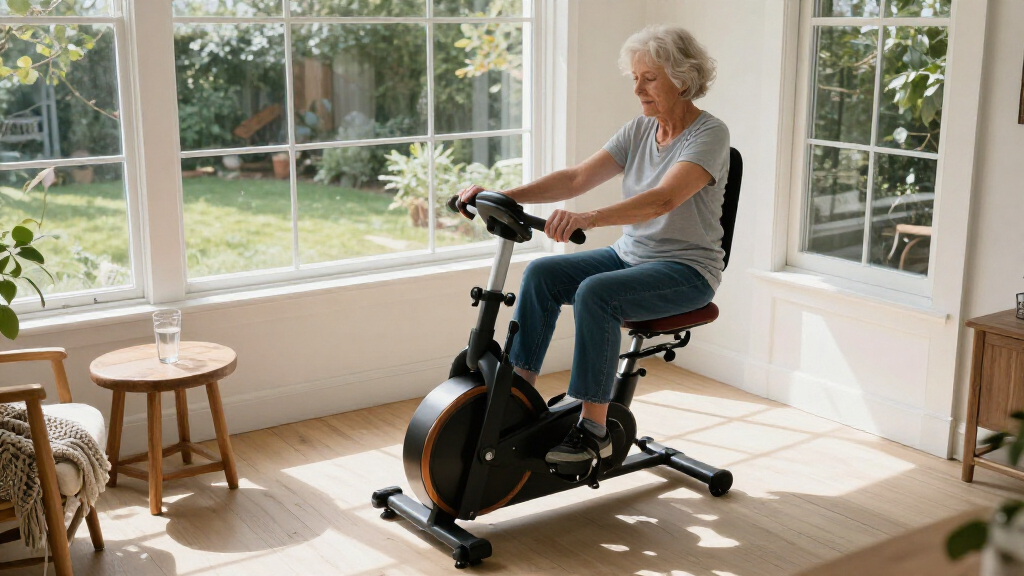
I ranked these machines around the needs that most affect senior buyers: ease of getting on and off, seated support, low-impact movement, resistance adjustability, and room requirements. I also weighed how demanding each movement pattern may feel, since rowing, standing elliptical motion, and seated pedaling place different demands on coordination and comfort. Product names and listed specifications can signal what a machine offers, but they cannot establish a personal fit or replace checking the manufacturer’s dimensions and user guidance.
The ranking favors equipment that appears more approachable for a broad range of home exercisers, with seated machines ahead of options that ask for more balance or coordinated movement. I gave additional weight to adjustability and practical versatility, while treating folding or compact designs as useful only when their access and fit also make sense. The rowers and standing ellipticals remain worthwhile for buyers who want those movement styles, but they rank lower for a general senior audience because the right fit depends more heavily on comfort, mobility, and confidence using the machine.
Factors to Consider When Choosing Best Home Cardio Machines For Seniors
Choosing a machine is less about finding the most demanding workout and more about selecting one you can use comfortably and regularly. I’d sort options by access, movement style, available space, and how easily the machine fits into your routine before comparing feature lists.
Start With Getting On and Off
Think through the full routine: approaching the machine, sitting or standing, placing your feet, and leaving after exercise. A seated design can reduce the balance demands of mounting, but seat height, reach, and the path to the pedals still matter. A folding frame may save floor space while adding steps to setup or storage, so ask whether you will realistically fold it after every session. Avoid judging access from product photos alone; check dimensions and look for a clear view of how the seat and frame are arranged. If mobility, balance, or joint comfort is a concern, discuss suitable exercise equipment with a health professional before buying.
Match the Movement to Your Comfort
Recumbent bikes, seated ellipticals, rowers, and standing ellipticals do not feel interchangeable, even when each offers low-impact exercise. Pedaling may be easier to understand than coordinating a rowing stroke, while a seated elliptical can involve both arms and legs depending on its design. A standing elliptical asks the user to remain upright throughout the session, which may not suit someone who wants added seat support. Do not assume that a machine is comfortable simply because it is described as low impact. If possible, try a similar movement in person or ask a clinician whether the motion suits your range of movement and exercise goals.
Look Beyond Resistance-Level Counts
A large number of resistance settings does not tell you how gentle the first setting feels or how smoothly the machine changes between levels. For a new exerciser, the lowest usable setting and simple adjustment controls may matter more than a high maximum. Ask whether you can alter resistance while seated and whether the controls are easy to read and reach. When comparing magnetic and hydraulic systems, focus on the adjustment method, movement feel, and care instructions rather than assuming one type will suit everyone. A machine you can start comfortably and adjust without interrupting your routine is often a better match than one with a longer feature list.
Measure the Exercise and Storage Footprint
Measure the machine’s working area, not only its stored dimensions. Allow room to step beside it, reach the controls, and move safely around the frame; a tight corner can make a compact machine awkward to use. Check whether folding requires lifting, bending, or moving parts, and whether the unit has a storage position you can manage. Also confirm that the floor can support the machine and that the exercise area has suitable lighting and a stable surface. These checks can prevent a common mistake: buying for the space a machine occupies when folded, then finding there is no comfortable place to use it.
Prioritize Fit, Support, and Clear Controls
Comfort depends on more than padding: the seat, pedal spacing, handle reach, and the machine’s stated user-fit limits all affect whether a session feels manageable. Check the manufacturer’s specifications against the intended user rather than assuming a household machine will fit everyone. Controls should be easy to locate and understand, particularly if you want to adjust resistance without leaning or stopping. A screen can be helpful, but it is not a substitute for a stable setup and comfortable movement. If two machines seem similar, choose the one with clearer fit information and controls you can operate confidently.
Know When Extra Features Are Worth It
Paying more attention to a feature makes sense only when it solves a real problem, such as limited storage, a need for seated support, or a preference for upper- and lower-body movement together. Extra resistance settings or a more elaborate display may add little if your main goal is gentle, regular activity. On the other hand, a better-fitting seat or a frame that works in your available room can matter every time you exercise. Compare warranty terms, assembly requirements, and maintenance instructions before choosing between otherwise similar designs. I’d put comfort and everyday usability ahead of features you do not expect to use.
Frequently Asked Questions
Which type of cardio machine is a sensible starting point if I feel unsteady?
A seated machine is often a practical place to start because it avoids exercising while standing, but the safest choice depends on your balance, mobility, and ability to mount the equipment. A recumbent bike or seated elliptical may feel more accessible than a standing elliptical or a rower that requires coordinated movement. Check the machine’s access and controls, and try the movement if you can before committing. If you have a fall history or a medical condition that affects exercise, ask a health professional for guidance on suitable equipment and supervision.
Is a rowing machine a good choice if I have limited mobility?
It depends on what limits your movement. Rowing typically involves bending and extending the knees and hips, moving the torso, and coordinating the arms with the legs, which may be uncomfortable or difficult for some people. A recumbent bike or seated elliptical may ask for less coordination, though those options still require a comfortable range of movement. Check the rower’s seat travel and entry access, not just its resistance settings. If mobility limits are related to an injury or health condition, ask a clinician whether rowing is appropriate before choosing one.
Should I choose a folding machine if I have limited space?
Folding can help, but it is not the only measure of whether a machine works in a small home. You need enough clear floor space to exercise safely, and the folded unit must be easy to move and store without strain. Some compact machines still take up substantial room while in use, and frequent setup can discourage regular sessions. Measure both the operating and storage footprints, then consider whether you can handle the folding steps. A nonfolding seated machine that stays in a usable corner may be more practical than one you have to assemble or reposition each time.
How much resistance range do I need for gentle home exercise?
There is no single number of resistance settings that guarantees a comfortable workout. What matters most is whether the machine’s lowest level feels manageable and whether adjustments are straightforward as your needs change. A long list of levels can be less useful than clear controls and smooth changes between settings. Check the manufacturer’s description and, when possible, try the machine at its easiest setting. If you are returning to exercise after a break or have specific health concerns, ask a qualified professional about a suitable starting intensity.
What should I check before buying a machine for two people?
Compare both users’ fit needs against the manufacturer’s user limits, seat or stride dimensions, and handle reach. A machine that feels comfortable for one person may require awkward adjustments for another, so check whether settings can be changed easily between sessions. Consider access as well: the person who has more difficulty mounting the machine should guide the choice. If one user prefers seated movement and the other wants rowing or standing exercise, a single machine may involve a meaningful compromise. Whenever possible, have both people try the same movement before buying.
Conclusion
For a broad senior audience, I’d choose the JLL E110S Seated Magnetic Elliptical as the best overall starting point because its seated format offers an approachable alternative to standing exercise and rowing. The Sunny Health & Fitness Compact Hydraulic Rower is my value-minded pick for buyers who want a smaller rowing option and are comfortable with that movement style. For a premium-style full-body choice, consider the Sunny Health & Fitness Elite Recumbent Cross Trainer; for beginners who want a straightforward seated routine, the XVGVSV Recumbent Exercise Bike is the clearest fit. If your specific priority is a coordinated full-body workout, compare the YOSUDA, YPOO, and MERACH rowers, while buyers wanting standing elliptical motion can look at THERUN or ANCHEER. Before deciding, match the machine’s access, dimensions, and movement to the person who will use it most.